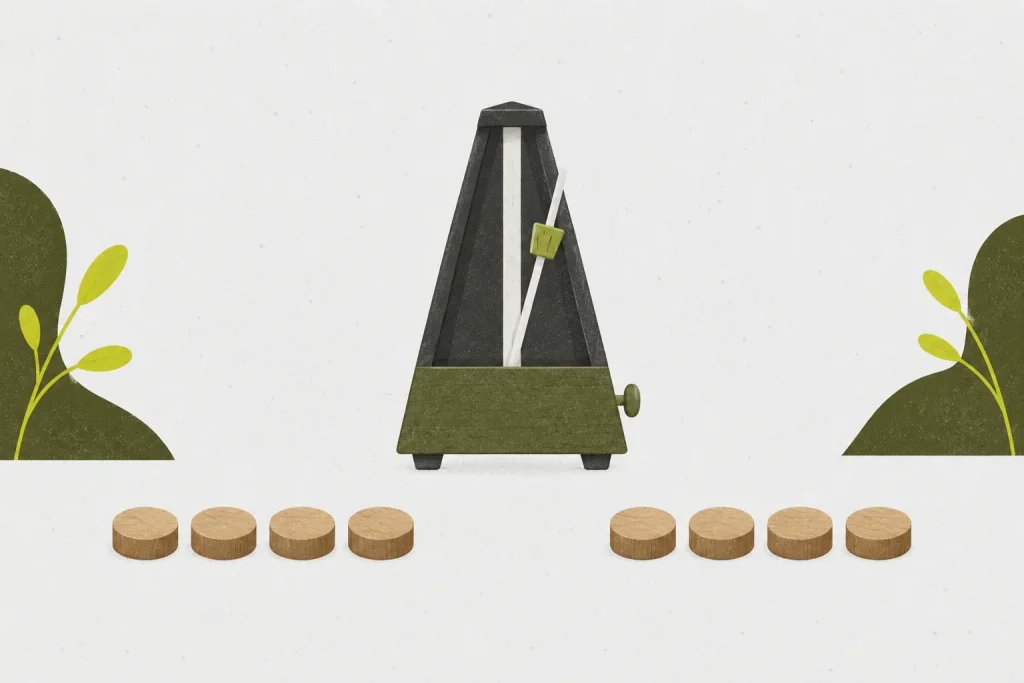
Time Signatures for Beginners: What the Two Numbers Mean
A time signature identifies a beat-grouping framework and a note-value unit. Learn 4/4, 3/4, 2/4, and the crucial difference in 6/8.

Written music carries two jobs at once: it shows which sound to make and when to make it. This path separates those jobs before putting them back together. You will use landmarks, distances, and counting instead of depending on long strings of mnemonics. Every example leads to a short read, clap, or play check.
Lessons in this path
Start with the title that matches the problem you can name today.
A time signature identifies a beat-grouping framework and a note-value unit. Learn 4/4, 3/4, 2/4, and the crucial difference in 6/8.
Understand whole, half, quarter, and eighth durations as relationships, then count sounds and silences inside one steady 4/4 framework.
Treble and bass clefs are two pitch maps for the same five-line staff. Learn their G and F landmarks, then connect both through middle C.
Use a few stable landmark notes, read direction and distance, and verify the result before mapping it to your instrument.
Read the page in two passes: find pitch from the clef and staff, count duration from note shapes and meter, then combine both in one checked example.
Move between skills