Treble clef and bass clef for beginners make more sense when you treat them as two maps, not two unrelated symbol lists. Both use a five-line staff. Each clef assigns different pitches to those positions so music can fit its useful range with fewer ledger lines.
Treble clef centers a G landmark. Bass clef centers an F landmark. Middle C connects the two.
The difference at a glance
| Feature | Treble clef | Bass clef |
|---|---|---|
| Other name | G clef | F clef |
| Landmark line | Second line from bottom = G4 | Second line from top = F3 |
| Typical use | Higher ranges | Lower ranges |
| Staff lines, bottom to top | E4–G4–B4–D5–F5 | G2–B2–D3–F3–A3 |
| Staff spaces, bottom to top | F4–A4–C5–E5 | A2–C3–E3–G3 |
| Middle C | Ledger line below | Ledger line above |
These are written-pitch labels in common concert-pitch examples. Some instruments transpose or use octave clefs, so sounding pitch can differ from the written label.
What a clef does
A bare staff tells you that higher positions represent higher written pitches, but it does not fully name them. The clef provides the pitch reference.
Open Music Theory describes the treble clef as wrapping around the G line and the bass clef as marking the F line (Reading Clefs). Once one line is named, the other lines and spaces follow the repeating letter sequence A–B–C–D–E–F–G.
Treble clef: start from G
The treble clef’s curl surrounds the second line from the bottom. That line is G4, the G above middle C.
From G4:
- the space immediately above is A4;
- the next line is B4;
- the space immediately below is F4;
- the bottom line is E4.
Treble clef is common for higher voices and instruments. Guitar and tenor voice often use treble notation that sounds an octave lower than written, sometimes indicated with a small 8 below the clef.
Bass clef: start from F
The bass clef’s two dots sit around the second line from the top. That line is F3, the F below middle C.
From F3:
- the space immediately above is G3;
- the top line is A3;
- the space immediately below is E3;
- the middle line is D3.
Bass clef is common for lower voices and instruments. Instruments with wide ranges may change clefs to keep the notation readable.
Middle C connects the maps
Middle C (C4) sits on a ledger line below the treble staff and on a ledger line above the bass staff. Those are two notations for the same pitch.
On a piano grand staff, treble normally appears above bass and the staves are joined. The grand staff is a continuous pitch map, not “right-hand notes” and “left-hand notes” by definition. Pianists often divide hands that way, but either hand can cross or play in another range.
Read from landmarks and distance
Long mnemonic sentences can help you check line and space names, but they can hide contour. Use this order:
- Identify the clef.
- Locate G4, F3, or middle C.
- Notice whether the next note moves up, down, or repeats.
- Count adjacent line/space positions.
- Name the destination pitch.
The staff-note landmark guide provides a focused drill for this method.
Practise both clefs without mixing the maps
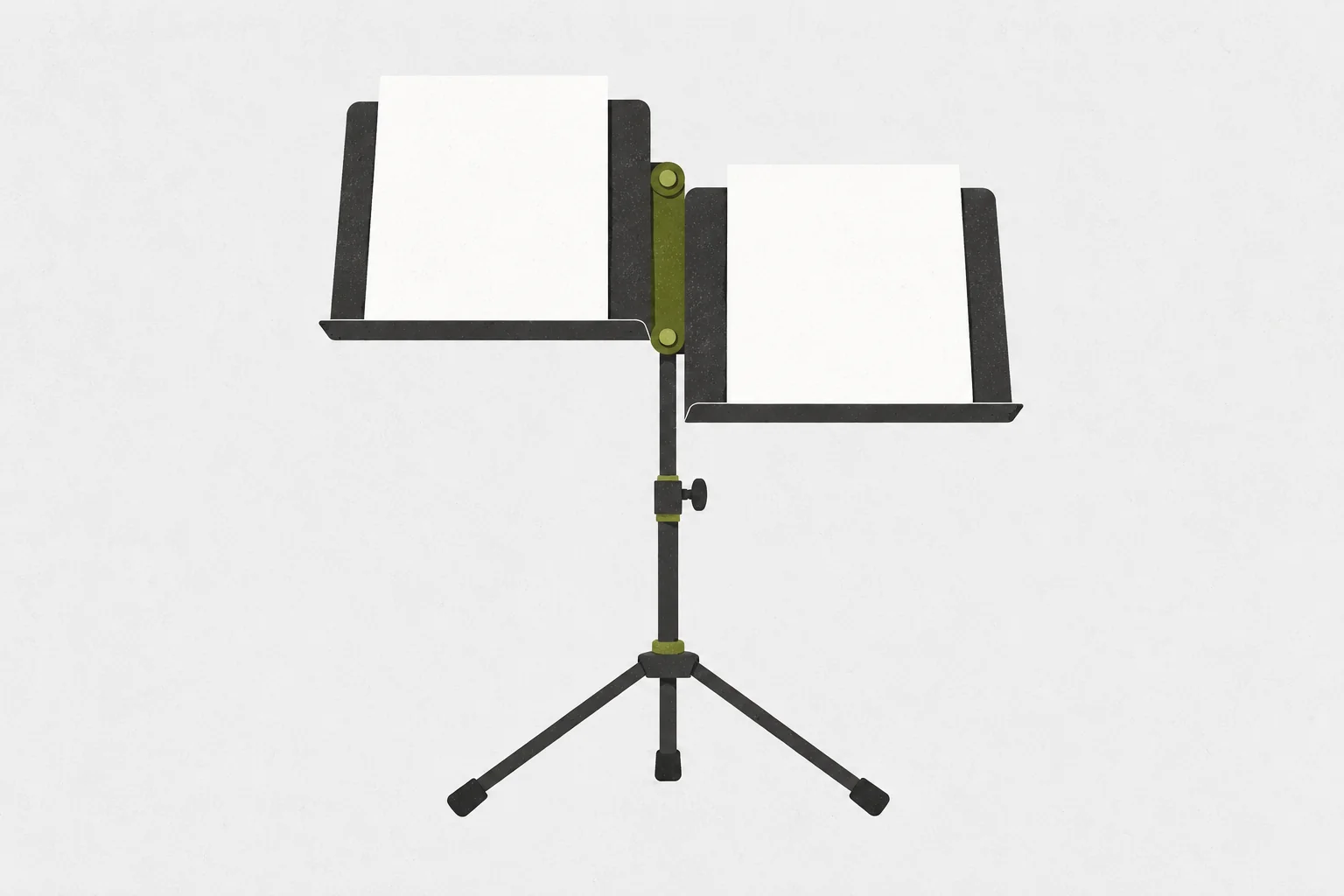
The same staff position has a different name under each clef. For example, the second line from the bottom is G4 in treble clef but B2 in bass clef. Do not switch by mentally moving every bass note from a treble answer. Start from the active clef’s own landmark.
Use two short rounds:
- In treble clef, identify G4, then read two notes above and two below it.
- Pause, name the bass F3 landmark, then read two notes above and two below it.
- End both rounds at middle C so the maps reconnect.
Keep the staves visually separate while learning each anchor, but compare them after every round. If you give a treble name on the bass staff, stop and point to the F line before trying again.
Success check: you can explain why one visual position changes name when the clef changes, then locate the correct landmark without reciting every line name.
A five-minute clef-switching exercise
Hear
Play or sing middle C, then a nearby note above and below if your instrument and range allow. Listen for the same center pitch before looking at notation.
Understand
Middle C can be written below treble or above bass. The clef changes its staff placement, not the pitch itself.
Try
- Point to treble G4 and move down through F4, E4, D4, to middle C.
- Point to bass F3 and move up through G3, A3, B3, to middle C.
- Say the letter sequence in both directions.
- Cover the labels and repeat.
Success check: find middle C from either clef without counting every line from the bottom.
Which clef should you learn first?
Learn the clef used by your present music. Many singers and melody instruments begin in treble. Lower-range instruments often begin in bass. Piano learners need both, but can practise one staff at a time before coordinating them.
Do not add a clef because it seems more advanced. Add it when your repertoire uses it or when ledger lines become harder to read than a clef change.
Common clef mistakes
Applying treble names to a bass staff
Pause at the start of every system and name the clef landmark. The same visual position is not the same pitch under both clefs.
Assuming treble means right hand and bass means left hand
Clefs organize pitch range, not body parts. Hand assignments are performance choices shown by context.
Treating middle C as two different notes
Play both notations on the same instrument location. The two spellings connect the maps.
Ignoring octave indicators or transposition
An 8 attached to a clef can shift the sounding octave. Transposing instruments have additional written-to-sounding relationships. Follow your instrument’s notation convention.
Frequently asked questions
Why not use one clef for every pitch?
One clef would force many notes far beyond the staff onto ledger lines. Multiple clefs keep common ranges nearer the five-line staff.
Are treble and bass clef the only clefs?
No. Alto, tenor, percussion, and other clefs serve different ranges and functions. Beginners should learn the clef their music requires.
Should I memorize all line and space names?
Direct recognition develops with use. Start with G, F, and middle C, then build outward through short musical patterns rather than drilling only isolated notes.
Your next reading step
Use the staff-note guide to practise landmark reading, then return to the complete sheet-music method to combine pitch with duration. When accidentals begin to appear regularly, continue to key signatures for beginners.