Major and minor triads are three-note chords built from a root, a third, and a fifth. A major triad contains a major third above the root and a perfect fifth. A minor triad contains a minor third above the root and the same perfect fifth.
Compare C major, C–E–G, with C minor, C–E-flat–G. Only the third changes. That one-note change alters the chord’s interval structure and quality.
Difficulty: Beginner
Estimated time: 15 minutes
Prerequisites: Count generic thirds and fifths
What you’ll need
- A keyboard, pitched instrument, notation app, or three voices
- The note names for one familiar major scale
- The checked triad diagram below
- Optional recording for listening comparison
Quick overview
| Step | Action | C example |
|---|---|---|
| 1 | Choose the root | C |
| 2 | Add a note a third above | E or E-flat |
| 3 | Add a perfect fifth above root | G |
| 4 | Check quality | C major or C minor |
| 5 | Play broken, then together | C–E–G / C–E-flat–G |
Step 1: Choose and keep track of the root
The root names the triad. Begin on C. In root position, place C at the bottom, then stack the other chord notes in thirds above it.
Open Music Theory defines a triad as a three-note chord whose notes can be arranged in thirds. In compact root position, the notes are root, third, and fifth.
Step 2: Build the major triad
From C, count a generic third to E and a generic fifth to G:
C — E — G
C to E is a major third. C to G is a perfect fifth. Those intervals from the root define a C major triad.
You can also see the internal stacked thirds: C–E is a major third and E–G is a minor third.
Step 3: Lower the third to build the minor triad
Keep C and G. Lower only E to E-flat:
C — E♭ — G
C to E-flat is now a minor third. C to G remains a perfect fifth. The result is C minor.
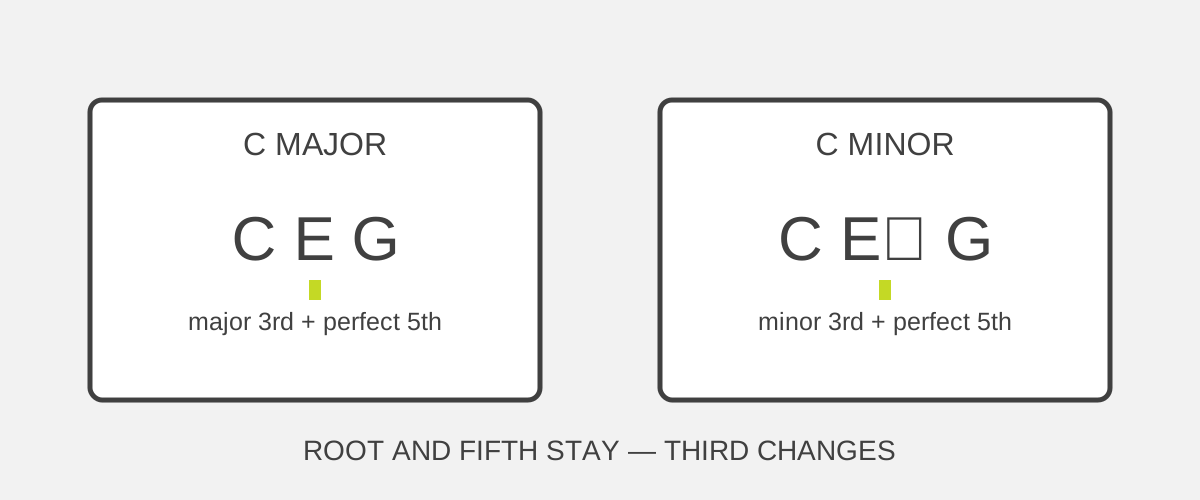
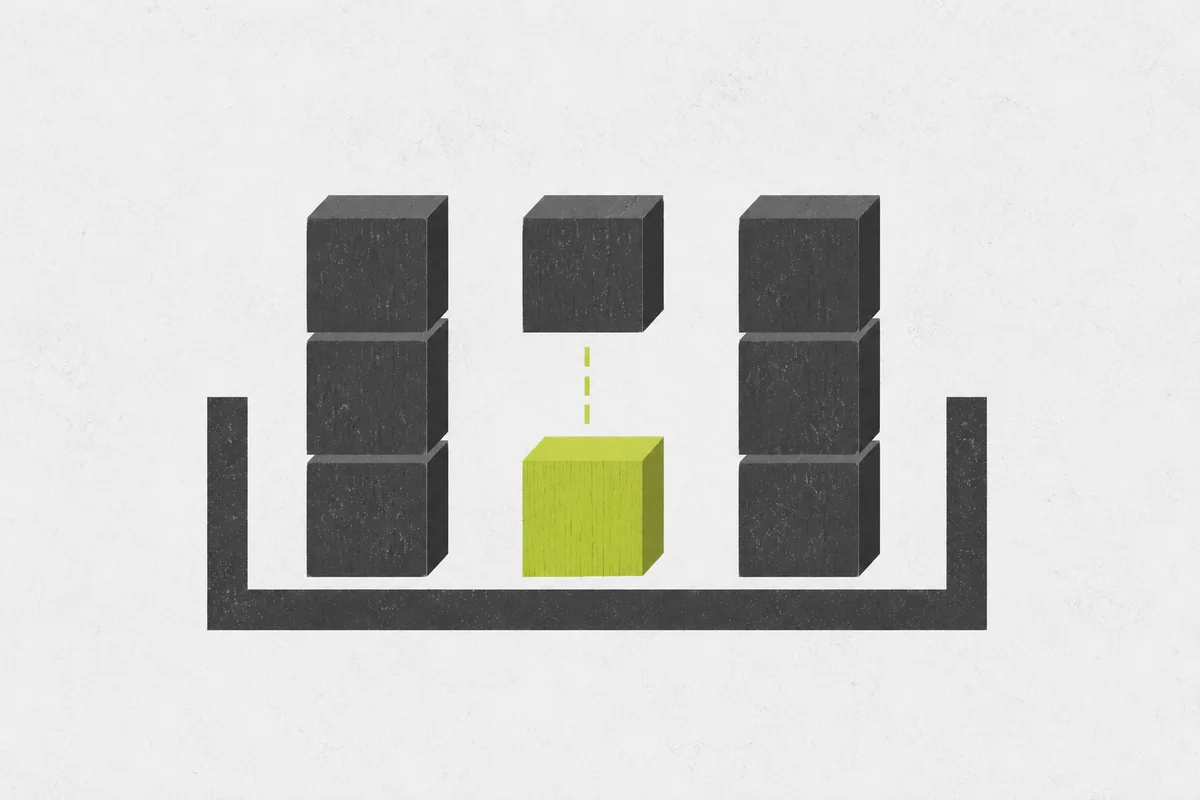
The outer fifth remains stable while the third changes. This is the most efficient comparison because it controls two notes and changes one variable.
Tip: Play C and G first as an open fifth. Add E, then replace it with E-flat. Listen to what the middle note contributes.
Step 4: Check the spelling, not only the keyboard shape
Triads in thirds use alternating letter names. A C triad must use C, some kind of E, and some kind of G. D-sharp may share a key with E-flat on an equal-tempered keyboard, but C–D-sharp–G is not the conventional spelling of C minor because C to D-sharp is an augmented second, not a third.
Correct spelling shows the chord’s structure. Count letters first; then apply accidentals.
Step 5: Hear the notes separately and together
Play each triad as a broken chord, one note at a time. Then sound the three notes together if your instrument allows. This connects melodic intervals with harmonic sound.
Avoid the shortcut “major is happy, minor is sad.” Chord quality contributes to musical color, but tempo, register, rhythm, voicing, dynamics, timbre, and context all affect emotional interpretation. Major and minor are interval structures, not fixed emotions.
Hear → Understand → Try
Hear
Play C–G, then add E. Repeat C–G, then add E-flat. Listen to the changed third while the root and fifth remain constant.
Record both versions at the same volume and register so the comparison isolates chord quality.
Understand
Both chords have root C and perfect fifth G. A major third produces the major triad; a minor third produces the minor triad.
Try
- Write F as the root.
- Count a third and fifth: F–A–C.
- Play it as F major.
- Lower A to A-flat while keeping F and C.
- Play F–A-flat–C as F minor.
Success check: you can explain the quality change by naming the altered third, not by describing an emotion.
Repeat the process from G or D. Write the letter stack first, then verify the accidentals on your instrument before naming the quality.
Common mistakes and fixes
Changing the fifth as well as the third
Symptom: The comparison no longer isolates major versus minor.
Fix: Keep root and perfect fifth fixed; lower only the major third by one half step.
Counting semitones but misspelling the chord
Symptom: The sound is plausible but the letters do not form stacked thirds.
Fix: Build root–third–fifth by letters first, then adjust accidentals.
Assuming the lowest sounding note is always the root
Symptom: Inverted triads are misnamed.
Fix: Rearrange the pitch classes mentally into stacked thirds. The lowest performed note can be the third or fifth.
Playing too many octaves
Symptom: Doublings hide the three essential pitch classes.
Fix: Reduce to one C, one E or E-flat, and one G before expanding the voicing.
Frequently asked questions
Are major and minor the only triad qualities?
No. Diminished and augmented triads are also standard qualities. Major and minor are the clearest first comparison because both use a perfect fifth.
Does note order change the chord name?
Reordering the same three pitch classes creates an inversion or voicing, but the root and quality remain. C–E–G, E–G–C, and G–C–E are all C major triads.
Can I build triads from a scale?
Yes. Choose a scale degree, then take alternating notes from the scale. The resulting quality depends on the interval pattern.
Where do triads go next?
Hear them in sequence in What Are Chord Progressions? and reinforce the prerequisite with Music Intervals for Beginners.
Summary
Build the root, third, and fifth by letter name. A major third plus perfect fifth above the root creates a major triad; a minor third plus the same perfect fifth creates a minor triad. Change one note, listen, and name the interval—not a mood stereotype.