Key signatures for beginners are easiest to understand as recurring pitch instructions. A key signature appears after the clef and before the time signature. Its sharps or flats normally apply to every matching letter name in any octave until the key signature changes, unless a local accidental modifies a note.
It reduces repetition on the page. Instead of placing a sharp before every F in G major, the score places F-sharp in the key signature.
Difficulty: Beginner
Estimated time: 15 minutes
Prerequisites: Know note letters and the idea of a major scale
What you’ll need
- A short score with a visible clef and key signature
- Pencil or note-naming app
- The checked order diagram below
- Optional instrument for playing the affected notes
Quick overview
| Step | Action | Example |
|---|---|---|
| 1 | Locate the signature | after clef, before time signature |
| 2 | Name each accidental’s letter | one sharp: F-sharp |
| 3 | Apply it across octaves | every written F is normally sharp |
| 4 | Identify a likely major key | one sharp → G major |
| 5 | Verify with the scale and musical context | G A B C D E F-sharp G |
Step 1: Locate the key signature
At the start of a staff, read in this order:
clef → key signature → time signature
The clef establishes pitch positions. The key signature supplies recurring sharps or flats. The time signature describes metric organization. Do not confuse the accidental group with the two numbers of the time signature.
Open Music Theory’s major-scales chapter places key signatures after the clef and before the time signature and explains how they collect scale accidentals.
Step 2: Learn the fixed order of sharps and flats
Sharps enter key signatures in this order:
F C G D A E B
Flats use the reverse order:
B E A D G C F
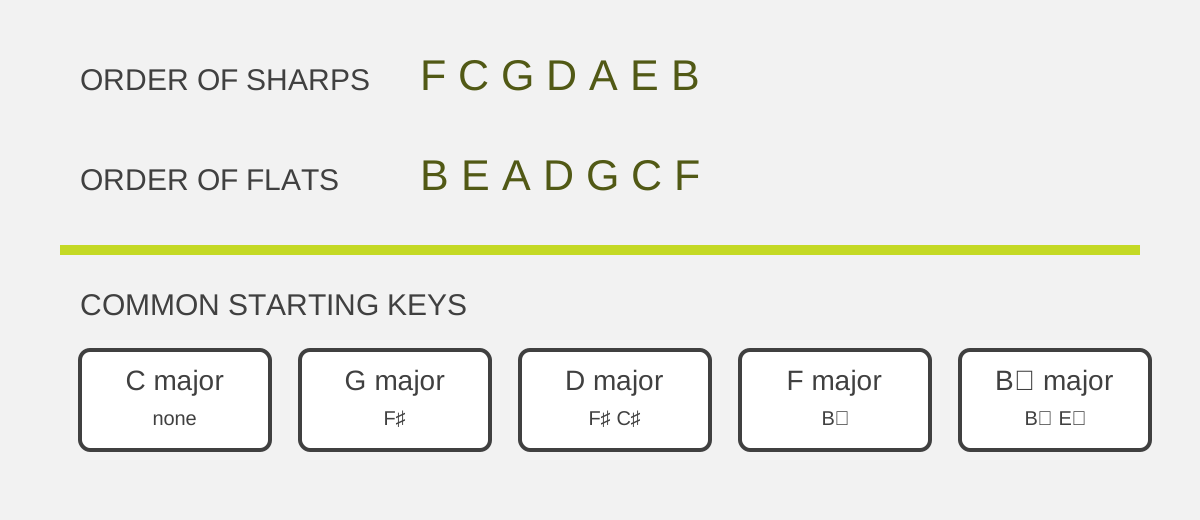
You do not need to memorize every key at once. Begin with no accidentals, one sharp, and one flat:
- C major: no sharps or flats
- G major: F-sharp
- F major: B-flat
Then add D major with F-sharp and C-sharp, and B-flat major with B-flat and E-flat.
Step 3: Apply each accidental to the letter name
If the key signature contains F-sharp, every written F is normally performed as F-sharp, regardless of octave. The placement on the staff tells the reader which letter is affected; the instruction applies to that pitch class throughout the staff.
A local natural, sharp, or flat can temporarily modify a note according to notation rules and the measure. Read those accidentals separately from the standing key signature.
Tip: Before playing, scan the signature and say the affected letters aloud: “all Fs sharp,” not merely “one sharp.”
Step 4: Identify common major keys
For sharp major-key signatures, the final sharp is one half step below the major tonic. One sharp is F-sharp; one half step above is G, so the likely major key is G major.
For flat major-key signatures with two or more flats, the second-to-last flat names the major key. B-flat and E-flat has B-flat as the second-to-last flat, so it indicates B-flat major.
Two exceptions must simply be known:
- C major has no sharps or flats.
- F major has one flat, B-flat.
These methods identify the associated major key. The same signature can also belong to its relative minor key, so the notes and tonal center of the music provide the final answer.
Step 5: Verify with the scale and context
One sharp gives this G-major scale:
G A B C D E F♯ G
The scale follows the major-scale pattern and uses exactly the F-sharp shown in the signature. Play or write the scale to check the result.
But a signature alone does not prove that every passage is straightforwardly in that major key. Relative minor, modes, tonicization, and chromatic notes can change musical context. For a beginner exercise, identify the likely major key, build its scale, then listen for a stable home pitch.
Hear → Understand → Try
Hear
Play C major: C D E F G A B C. Then play G major: G A B C D E F-sharp G. Listen to the final half-step motion F-sharp to G.
Understand
The G-major collection needs F-sharp to preserve the major-scale pattern. The key signature records that recurring alteration once at the start of each staff system.
Try
- Write the first two sharps in order: F-sharp, C-sharp.
- Use the last-sharp method: C-sharp rises a half step to D.
- Write D major: D E F-sharp G A B C-sharp D.
- Check that the scale uses both signature sharps.
Success check: you identify D major from the signature and write its ascending scale without adding or omitting an accidental.
Common mistakes and fixes
Applying the accidental to one octave only
Symptom: One F is sharp but another F remains natural.
Fix: Translate the signature into a letter rule: every F is normally sharp.
Reading the last flat instead of the second-to-last
Symptom: Two flats are called E-flat major.
Fix: Point one place left from the last flat: B-flat names the major key.
Forgetting relative minor
Symptom: The signature is treated as proof of one major key.
Fix: Call it the associated major signature first; inspect the music’s home pitch and harmony.
Memorizing the circle without playing scales
Symptom: You name a key but miss its altered notes in performance.
Fix: Pair each new signature with writing, saying, and playing its scale.
Frequently asked questions
What does a key signature tell you?
It tells you which letter names are normally sharpened or flattened. It also points toward likely key relationships, but musical context confirms the tonal center.
Can a key signature contain both sharps and flats?
Standard major and minor key signatures use either sharps or flats, not a mixture. Local accidentals in the music may introduce other spellings.
Why are key signatures written differently in different clefs?
The staff positions change with the clef, but the affected letter names and order of accidentals remain the same.
Should I memorize the circle of fifths now?
Use it as a map after you understand what the accidentals do. Start with C, G, F, D, and B-flat major; add keys through real reading and scale practice.
Summary
Find the signature after the clef. Name its affected letters. Apply them across octaves. Use the last sharp or second-to-last flat to identify common major keys, then verify with the scale and musical context. Continue with What Are Scales in Music? and connect the reading position through Treble Clef and Bass Clef.