You do not need to feel motivated before every music session. Motivation changes with sleep, stress, novelty, progress, and the difficulty of the task. A durable practice system makes the next action small and obvious even when enthusiasm is low.
The goal is not an unbroken streak. It is a reliable return: reduce the friction to start, define a minimum session, collect visible evidence, and know exactly what to do after missed days.
The short answer
To stay motivated while learning music, attach a small practice action to a specific cue, choose one measurable target, and stop at a clear finish line. Keep a minimum version for difficult days and a written restart rule for missed sessions. Review recordings or notes weekly so slow changes become visible.
Frustration is information. It may mean the target is too large, the tempo is too fast, the feedback is unclear, the setup is inconvenient, or the material does not connect to music you care about. Diagnose the cause before calling yourself unmotivated.
First, name the kind of friction
“I don’t feel like practising” can hide several different problems.
| What you notice | Likely friction | First adjustment |
|---|---|---|
| You never begin | Instrument or materials are hard to access | Prepare the space and define a cue |
| You begin but wander | The task is vague | Write one target and one success check |
| You repeat the same mistake | Task or tempo is too difficult | Reduce the unit and slow it down |
| You cannot hear improvement | Feedback arrives too late | Record a short baseline and weekly check |
| Practice feels unrelated to music | Exercise has no application | Use the skill in one phrase or song |
| You miss a day and abandon the week | Plan is all-or-nothing | Use a next-available-session restart rule |
| You dread pain, panic, or persistent distress | Problem may exceed ordinary practice frustration | Stop and seek appropriate qualified support |
You may have more than one. Pick the friction that blocks the next session, not the one that sounds most impressive to solve.
Reduce the distance between cue and first sound
An intention such as “practise more” does not say when the action starts. An implementation intention uses an if–then form: “If I finish dinner on Monday, Wednesday, or Friday, then I will set a ten-minute timer and begin with the four-beat exercise.”
A meta-analysis by Peter Gollwitzer and Paschal Sheeran found that specifying when, where, and how to act improved goal attainment across many domains. Applying that finding to music practice is an editorial inference, not proof that one schedule suits every musician.
Build a cue that already exists:
- after breakfast, open the score and clap one measure
- after work, put on headphones and play one slow repetition
- after a child’s bedtime, practise one quiet fingering pattern
- after a lesson, write the next target before packing away
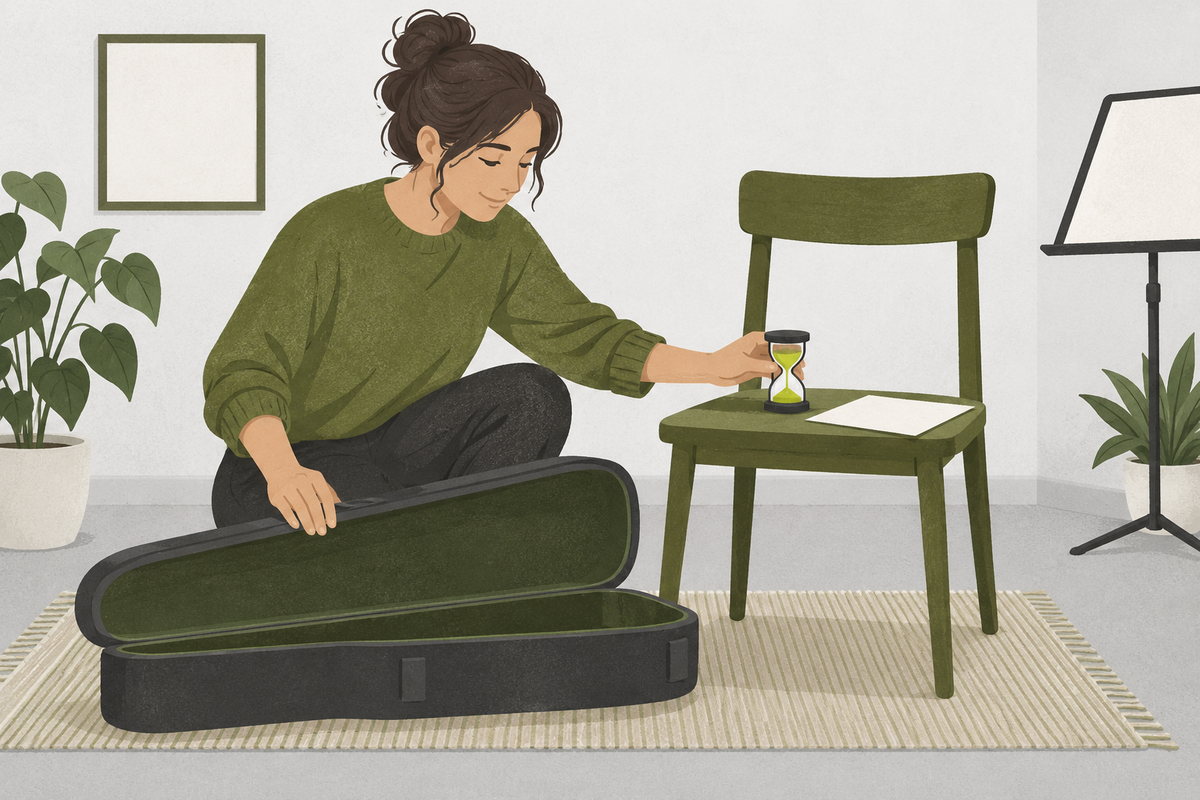
Prepare only what is safe to leave ready. Keep the instrument protected and follow its care requirements. You can still place the stand, pencil, timer, or practice note where it removes a small decision.
Set a minimum session that counts
Your minimum is the version you can do on a low-energy but otherwise safe day. It should be short enough to begin and specific enough to complete.
A useful five-minute minimum might be:
- one minute to set up and name the target
- two minutes on one difficult transition
- one minute applying it in context
- one minute to record the result and next step
Stopping after the minimum is allowed. Continuing is optional. The minimum protects the return path; it is not a trick that obliges you to do a full session.
Do not use the minimum to practise through pain, illness, or unsafe fatigue. Recovery can be the correct action.
Replace time goals with finish lines
“Practise for 30 minutes” measures attendance. A finish line describes what will be different at the end.
Compare:
- vague: work on scales
- clear: play the C-major scale up and down three times with even notes at a comfortable pulse
- vague: improve the song
- clear: connect measures 8 and 9 three times without stopping
- vague: do ear training
- clear: match five starting pitches and record the number matched on the first attempt
The success check should be observable but not punishing. Three accurate repetitions provide information; demanding perfection for an entire session turns the check into a threat.
The effective instrument-practice guide provides a longer target–attempt–feedback–application structure when you have more time.
Make progress visible without turning it into a verdict
Learning changes can be too gradual to notice from inside each session. Keep a low-burden evidence trail:
- date
- target
- starting condition or tempo
- one thing that changed
- next smallest step
Once a week, record the same short passage or exercise under roughly similar conditions. Compare this week’s take with the previous one. Listen for one dimension at a time: steadiness, correct notes, clean starts, tone, recovery, or continuity.
A recording is a sample, not your identity. Performance varies from day to day. Use it to decide the next task, not to rank your worth.
Research on psychological interventions for musicians finds a mixed evidence base overall; some feedback and self-regulation approaches are promising, but no single motivation technique is guaranteed. That is why this guide treats tracking as a diagnostic tool rather than a cure.
Hear → Understand → Try: a seven-minute reset
Hear
Play or sing a passage that currently feels unreliable. Record one attempt without stopping. Listen once and choose one audible issue—only one.
Understand
Translate the issue into a small mechanism. “It sounds bad” might become “the third note arrives early,” “the chord change includes a pause,” or “the starting pitch changes each time.”
Try
- Isolate one or two seconds around the issue.
- Reduce the tempo or simplify the motion.
- Make three attentive attempts, pausing to adjust after each.
- Put the fragment back into the surrounding phrase.
- Record one final attempt and write the next step.
Success check: you can state what changed, what did not, and where the next session begins. Improvement is welcome but not required for the session to count; a more precise diagnosis is useful progress.
What to do when a plateau feels endless
A plateau is a description of your recent evidence, not a universal stage with a fixed duration. Before waiting for motivation, change the information available.
Shrink the unit
Work on two notes, one breath, one transition, or one beat. Large sections can hide where the failure begins.
Change the feedback channel
Record audio, use a mirror appropriately, clap the rhythm, sing the line, write fingerings, or ask a teacher for one concrete observation. Choose feedback that reveals the target without adding unrelated complexity.
Lower difficulty without removing attention
Slow the tempo, remove ornaments, play one hand or voice, use open strings, speak counts, or practise only chord roots. Simplifying is not retreat. It isolates the mechanism.
Reconnect the drill to music
After two or three corrected repetitions, place the skill back into a phrase you care about. This tests whether the repair transfers and reminds you why the detail matters.
How to restart after a missed week
Do not repay missed practice with an oversized session. That makes returning more expensive.
Use this restart:
- Discard the debt. Missed minutes are gone; they do not accumulate.
- Check the baseline. Play one easy, familiar item and one current target.
- Choose one repair. Work on the first specific point of friction.
- Stop at the minimum. End while the next step is still clear.
- Schedule the next cue. Write the next available day, place, and first action.
If you stopped because the plan did not fit your life, change the plan. A restart that recreates the same conflict is not a reset.
Recovery success check: within one short session you produce one familiar sound, identify the current edge, and write the next cue. You do not need to regain your previous best performance immediately.
Use a two-level weekly plan
Separate a dependable floor from an optional ceiling.
Minimum week
- three five-minute sessions
- one target per session
- one weekly comparison recording
Full week
- three to five longer sessions as time and energy allow
- technical repair plus musical application
- lesson, ensemble, or external feedback if available
Both plans point toward the same skill. The minimum week is not a different identity; it is the version that keeps the return path open.
The exact schedule is an example, not a prescription. Habit-formation research shows substantial variation among people and behaviors, even when actions repeat in a stable context. Avoid promises that a practice habit will become automatic in a fixed number of days.
When comparison drains motivation
Another musician’s visible performance does not show their prior experience, teaching, instrument setup, available time, or edited attempts. Compare your current evidence to a matched earlier sample instead.
Use questions that lead to action:
- Which part is steadier than last week?
- Where does the first hesitation occur?
- What can I now do at a slower tempo that I could not do before?
- Which task repeatedly produces no useful feedback?
If community helps, choose a teacher, peer, or group that can give specific observations and respect your goals. Support is useful when it clarifies the work rather than turning every session into a performance.
Warning signs that need more than a motivation tip
Stop and seek appropriate help for pain, numbness, hearing changes, repeated dizziness, or injury concerns. If frustration becomes persistent hopelessness, severe anxiety, or affects daily life beyond music, a qualified health professional is more appropriate than a practice hack.
A teacher can help diagnose technique, repertoire fit, or task difficulty. An instrument technician can identify setup problems. Hearing and health professionals address concerns outside an editorial practice guide.
Your next session card
Write this on one card or note:
- Cue: After __, at ____, I will begin.
- Minimum: I will practise for ______ minutes.
- Target: I am changing ______.
- Check: I will know because ______.
- Recovery: If I miss it, my next available session is ______.
Then choose a mechanics route. Use the rhythm and timing guide if the pulse drifts, the sheet-music guide if decoding blocks the start, or the ear-training guide if you cannot yet hear what changed.
Motivation is welcome when it arrives. Your system should not require it. Make the first action visible, make the finish line small, and leave evidence that helps the next version of you begin.