What is ear training? It is the practice of noticing a musical detail, making or identifying a response, and comparing the two. You are training a feedback loop: hear, compare, respond, adjust.
That definition is deliberately modest. Ear training does not test whether you were born “musical.” It gives you repeatable ways to notice pitch direction, match a sound, echo a rhythm, remember a short phrase, and later identify intervals or chords.
You can begin without staff notation, specialist software, or a trained singing voice. Use your voice if it is comfortable, or answer on an instrument.
The short answer: what does ear training do?
Ear training connects a sound with a useful decision. When a note rises, can you hear the direction? When you play a phrase, can you tell whether your rhythm matches the example? When a melody stops, can you reproduce its first three sounds?
These are aural skills: skills for listening to, remembering, and responding to sound. In formal study they can include sight-singing and dictation, which means translating heard rhythm, melody, or harmony into a written representation. Open Music Theory’s aural-skills introduction treats tapping, contour, solfège, and provisional notation as different ways to support that work.
For a beginner, the first goal is simpler: make one comparison you can trust.
| Skill | Question you are learning to answer | Beginner response |
|---|---|---|
| Pitch direction | Did the second sound go higher, lower, or stay the same? | Point, say the direction, or choose one of three labels |
| Pitch matching | Does my sound line up with the target? | Hum, sing, or find it on an instrument |
| Rhythm echo | Did I preserve the pattern’s long/short and sound/silence order? | Clap, tap, or play one repeated note |
| Musical memory | Can I retain a short sound long enough to answer? | Reproduce two to four events |
| Recognition | Have I learned a reliable name for this relationship? | Identify an interval, scale degree, or chord quality later |
What ear training actually develops
Ear training is not one ability. A learner may match pitch accurately but lose a rhythm, hear melodic direction but struggle to sing it, or recognize a chord on piano but not with another timbre.
Separating those jobs matters. If a rhythm echo goes wrong, the cause might be memory, pulse, subdivision, or motor coordination. If a pitch match goes wrong, the target may be outside a comfortable range, your first note may hide the target, or you may need more time to compare.
This is why the loop includes a response and a check. Passive listening can be valuable, but a response reveals what you heard well enough to use.
Theory supplies names for those relationships. An interval, for example, describes the distance between two pitches. Intervals can sound one after another or together; the Open Music Theory interval guide calls those melodic and harmonic intervals. The label becomes useful after you can notice the relationship it names.
Start with two skills: matching pitch and echoing rhythm
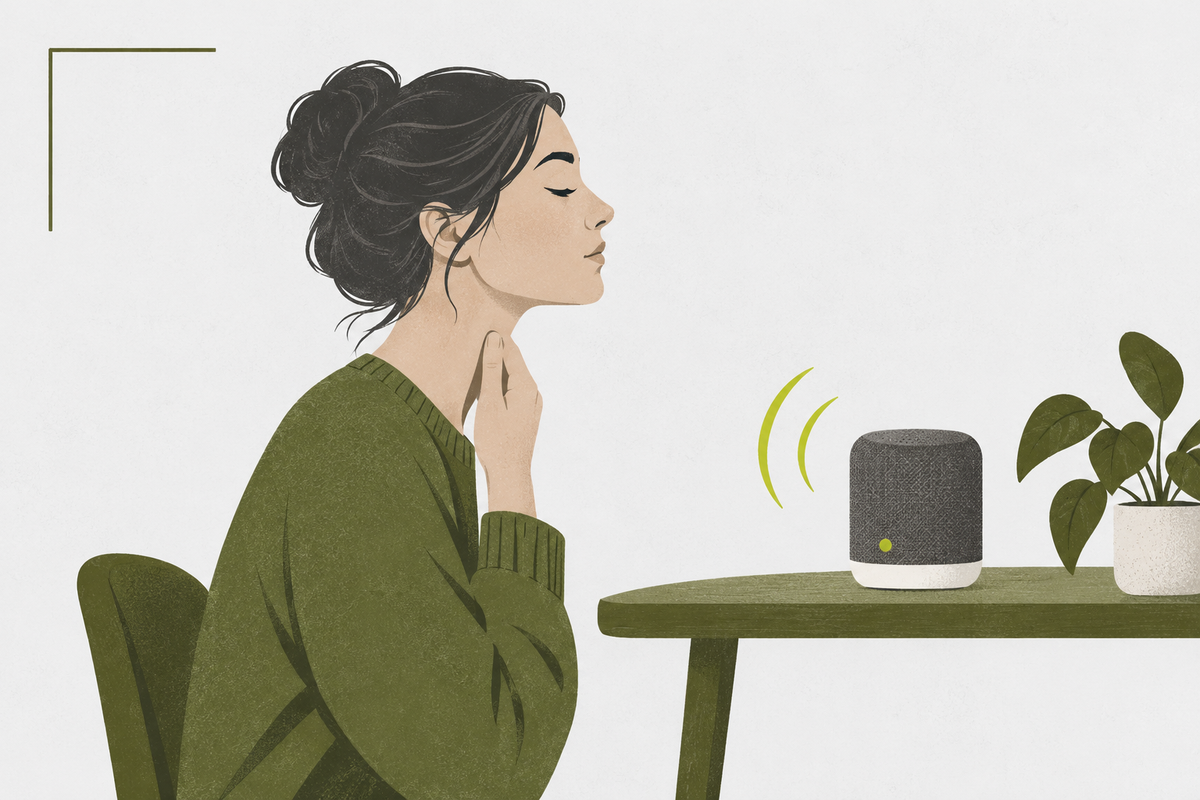
Pitch matching asks you to reproduce one target sound. Choose a note in a comfortable range. Play it, let it stop, then answer with your voice or instrument. If both sounds overlap safely on your instrument, alternately listen for beating or roughness, but do not rely on that cue alone; timbre and tuning make comparisons more complex.
Your first check is not “perfect or failed.” Ask:
- Did your response begin higher or lower than the target?
- Could you move toward the target on a second attempt?
- Could you repeat the match three times without searching farther away?
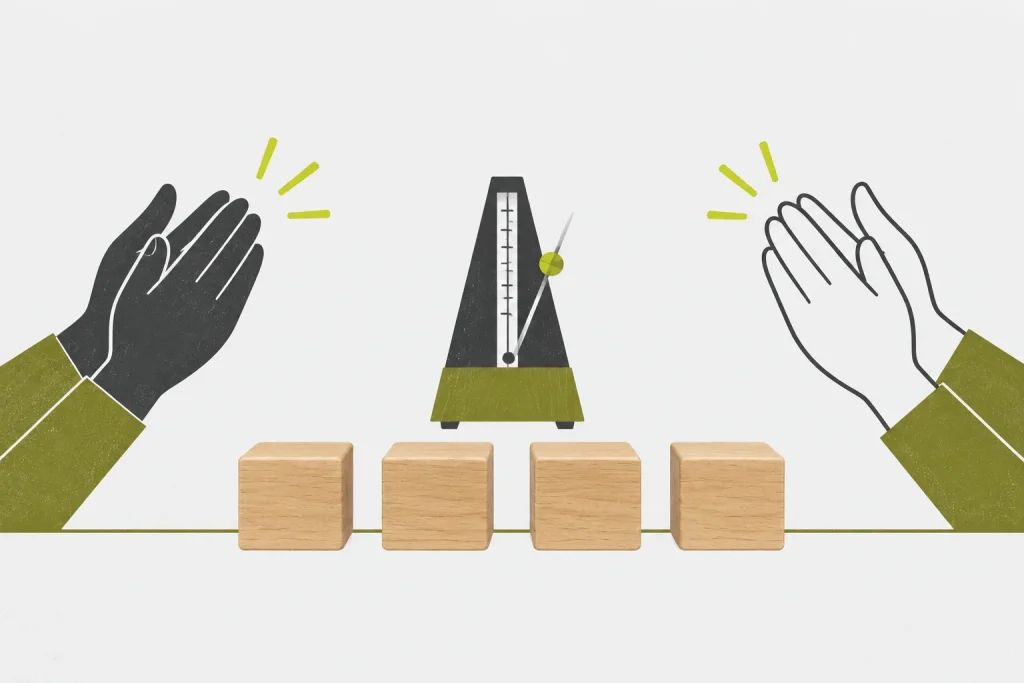
Rhythm echoing removes pitch from the task. Make every event the same clap, tap, or note. Start with four evenly spaced pulse taps, then use a short pattern such as clap, clap, rest, clap while the pulse continues.
Check the order first. Then check whether the underlying taps stayed even. The rhythm and timing guide develops that pulse layer separately.
Hear → Understand → Try: a five-minute ear-training loop
Use a timer only as a boundary, not as a score. One careful five-minute loop is more useful than a long series of guesses.
Hear
Choose one comfortable note. Listen once without answering. Listen again and notice three things: its general height, its tone color, and how it begins and fades.
Then hear this four-event rhythm, made by a helper or recorded in advance:
tap — tap — silence — tap
Keep four evenly spaced pulse positions underneath it. The silence occupies a place; it does not shorten the pattern.
Understand
Pitch and rhythm are separate layers in this exercise. The pitch task asks whether one sound aligns with another. The rhythm task asks whether events and silence land in the right pulse positions.
Do not name an interval, note, or chord yet. Naming is not the present success condition.
Try
- Play the target pitch, wait one second, and answer by humming, singing, or finding it on your instrument.
- Compare. Say “high,” “low,” or “matched closely enough to hold.”
- Repeat twice, changing only your starting response.
- Tap four steady pulse positions with one hand.
- With the other hand or your voice, reproduce sound, sound, silence, sound.
- Record the final pitch response and rhythm response on a phone or basic recorder if one is available.
Success check: the third pitch attempt moves less than the first, and the rhythm retains four equal positions with silence in position three. If only one layer passes, that result is useful: it identifies tomorrow’s target.
If vocalizing is uncomfortable or inaccessible, play the response on an instrument. If hearing access varies, pair the sound with visual tuner feedback or a helper’s comparison, while keeping the exercise’s goal explicit.
How intervals, chords, and dictation fit later
After you can compare isolated sounds, add labels gradually.
Melodic contour comes first: higher, lower, or repeated. Next, compare the size of two movements: which leap is wider? Only then attach interval names. Familiar-song mnemonics can help some learners, but they are memory cues rather than definitions and may not transfer across starting pitches or contexts.
Scale degrees describe a note’s position within a scale. Singing or playing 1–2–3–2–1 can help you hear movement relative to a home note. The guide to what scales are and why to learn them explains that map.
Chord recognition adds simultaneous pitches. Begin with contrast rather than a large quiz: same chord versus changed chord, then two qualities in one familiar register and timbre. Major and minor labels describe structure within common Western tonal practice; they are not universal emotional commands.
When that contrast is stable, connect it to the guide on how chord progressions work so the chord is heard in motion rather than as an isolated quiz item.
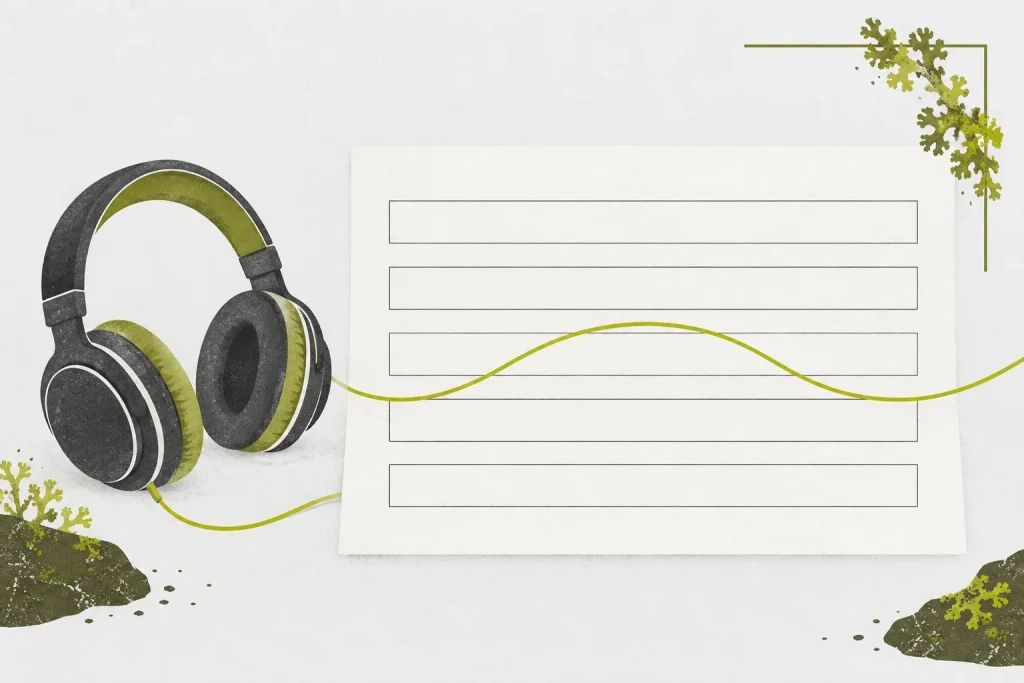
Dictation records what you heard. It can start without staff paper. Draw a contour line, place dots on four pulse positions, or write sound sound rest sound. Formal notation becomes valuable when it can preserve more detail. If you need that layer, begin with the two-pass sheet-music method.
Common problems and useful adjustments
“I cannot tell whether I am high or low”
Make the contrast obvious. Compare the target with one note clearly below it, then one clearly above it. Return to the target after each comparison. Narrow the distance only when the direction is reliable.
“My voice slides around the note”
Shorten the answer and use a comfortable syllable such as “mm” or “oo.” You may also answer on an instrument. Ear training and vocal control overlap, but they are not identical.
“I remember the first sound but lose the rest”
Reduce the phrase. Two events remembered accurately are a better starting point than six guessed events. Add one event after three accurate echoes.
“I score well in an app but cannot use the skill in music”
Change the context. Find the same relationship in a scale, a piece you are learning, or a phrase you create. Recognition drills sample one part of ear training; transfer needs musical use.
“Everything changes when the instrument changes”
Timbre affects what stands out. Practise one relationship with voice, your instrument, and one contrasting sound source. Keep pitch range and task difficulty stable while the timbre changes.
A seven-day beginner ear-training plan
Keep each session between five and ten attentive minutes. Stop before repeated guessing replaces comparison.
- Day one: Match one comfortable pitch three times and note whether you begin high or low.
- Day two: Echo two four-position rhythms using only sound and silence.
- Day three: Identify five obvious pitch directions: up, down, or same.
- Day four: Repeat day one with a different timbre, but the same comfortable range.
- Day five: Play or sing 1–2–3–2–1 in one familiar major scale.
- Day six: Draw the contour of a three-note phrase before trying to reproduce it.
- Day seven: Record the original pitch-and-rhythm loop and compare it with day one.
Spaced return and active recall are supported as general learning principles in the Institute of Education Sciences practice guide. This schedule is a practical application, not a promise that seven days produces a fixed level of skill.
Your next step
Ear training becomes useful when it changes the next attempt. Choose one response you can compare, keep the example short, and record what improved.
For structure, place this loop inside the feedback-led instrument practice routine. Review the practical music-theory map when you need a name for a relationship, or browse the Ear Training path for the next listening lesson.
Tomorrow, repeat the same target before adding difficulty. Success means you can describe the difference between attempts—not that every answer is already correct.