Active listening for musicians means giving one feature of a recording a specific job for your attention. Instead of replaying a track and hoping to notice more, you ask a narrow question, listen for evidence, and record one observation.
The method below uses five short passes: pulse, sections, melody, bass or harmonic support, and texture. You can use it with any genre and without naming every chord or instrument.
Difficulty: beginner
Estimated time: 15–20 minutes
You need: one familiar track, playback controls, and paper or a notes app
Choose a short listening window
Select 60–90 seconds with a clear beginning and end. Use the same excerpt for all five passes. A short window makes comparisons possible and prevents attention from resetting every time the music changes.
Keep playback at a comfortable level. Headphones can reveal detail, but speakers are fine. The goal is focused attention, not maximum loudness.
Quick overview
| Pass | Listen for | Write down |
|---|---|---|
| 1 | Steady pulse and grouping | Where the beat feels stable or shifts |
| 2 | Section boundaries | Timestamps where something changes |
| 3 | Main melodic contour | Up, down, repeated, or resting motion |
| 4 | Low line or harmonic support | Repetition, change, arrival, tension |
| 5 | Texture and dynamics | Entries, exits, density, loudness |
Pass 1: Track pulse before detail
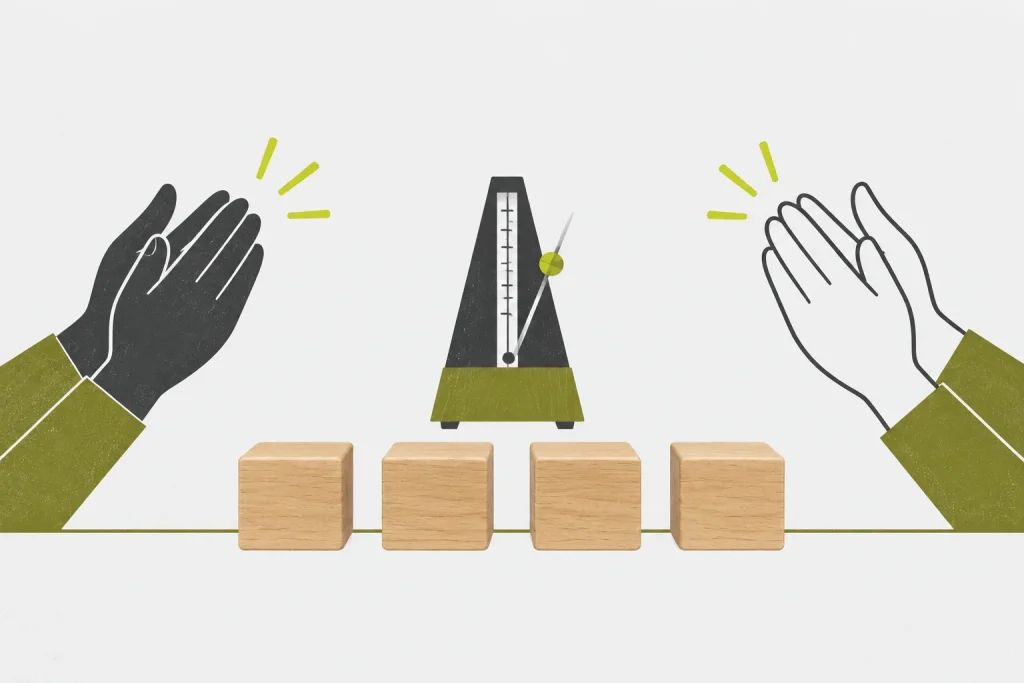
Tap quietly with the beat. If the beat becomes unclear, keep listening and resume when you can. Note whether the pulse remains steady and how beats seem grouped.
Meter can guide attention toward expected moments. In a laboratory study, physically identical tones at metrically strong points drew a larger early auditory response than tones at weaker points during engaged listening (Fitzroy and Sanders, 2015). You do not need the neuroscience to tap; the practical point is that the pulse creates expectations.
Write one sentence: “The beat feels steady, and the main change begins near 0:31.”
Pass 2: Mark section boundaries
Listen for a change in several features at once: new lyrics, a different chord loop, a drum entry, a pause, a register change, or a shift in density. Mark the timestamp.
Do not worry about labels such as verse or bridge yet. A neutral description—“full group enters”—is more useful than a confident but unsupported form label.
Success check: mark two boundaries and name the audible evidence for each.
Pass 3: Follow the main melodic contour
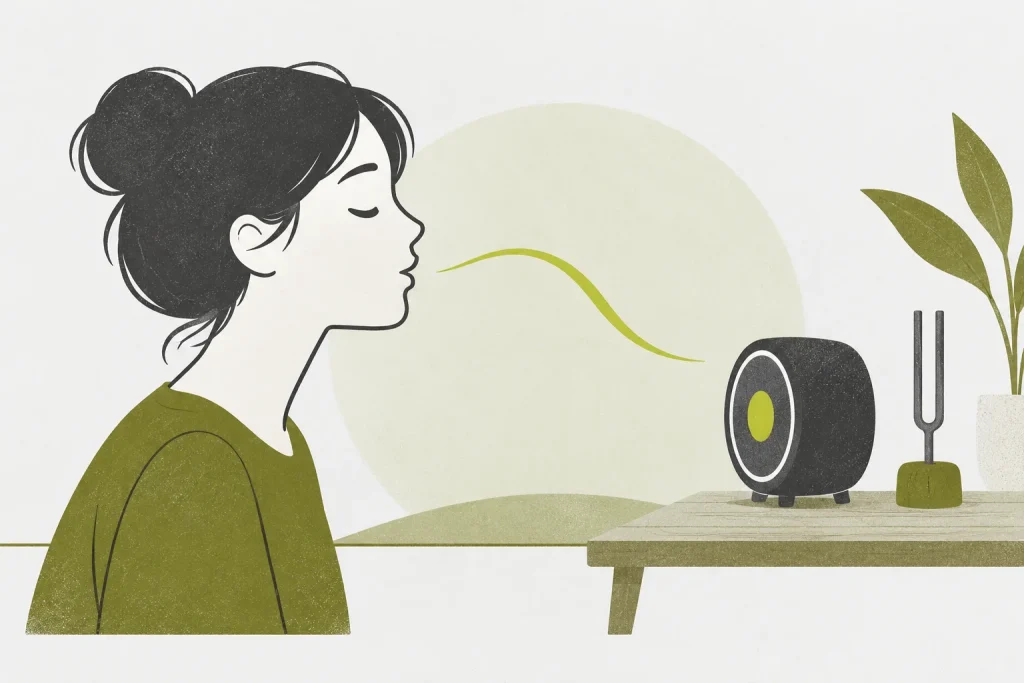
Hum lightly or trace the melody with one hand. Notice whether phrases rise, fall, repeat, leap, or settle. Contour is the shape of pitch movement; it does not require exact note names.
If two lines compete, choose the one you would most naturally sing back. The exercise is about maintaining one attentional thread.
Tip: If you can hear the contour but struggle to reproduce one of its notes, isolate one comfortable reference and match it before returning to the phrase.
Pass 4: Follow the low line or harmonic support
Shift attention away from the melody. Listen for the lowest repeating line, chord changes, or points that sound stable or unfinished. If the bass is hard to hear, use speakers at moderate volume and focus on change rather than pitch name.
Write patterns in plain language: “The low sound repeats for two phrases, then moves at the section boundary.” This observation is enough to connect hearing with later theory work.
Pass 5: Map texture and dynamics
Listen for how many layers are present and how their roles change. Mark entrances, exits, thickening, thinning, louder peaks, and quieter spaces.
Texture is not merely an instrument inventory. Ask which layer leads, supports, fills space, or creates motion. In one selective-attention experiment, listeners focused on one of two concurrent melodies while following its pitch contour, showing how a single musical stream can become a defined listening target (Steady-state responses to concurrent melodies).
Hear → Understand → Try: one observation log
Hear
Play the excerpt once without writing. Notice which layer captures you first.
Understand
Attention is limited. A five-pass method does not claim music has only five parts; it gives each chosen feature enough room to become audible.
Try
Complete the five passes and write one evidence-based sentence per pass. Finish with this prompt: “On the next listen, I want to verify ___ at ___.”
Finish line: five observations tied to audible evidence, not five theory labels.
Turn listening into practice
Choose one observation that changes what you will do on your instrument:
- clap the pulse through a section change;
- copy the melodic contour on one comfortable note, then with pitches;
- play the low line alone;
- imitate one dynamic shape;
- record eight bars and compare the balance of layers.
This creates a feedback loop: listen, predict, try, and compare. The ear-training foundation explains the same cycle across pitch and rhythm tasks.
Troubleshooting
“I keep hearing everything at once”
Lower the volume slightly, shorten the excerpt, and write the pass question before pressing play.
“I do not know the instrument names”
Describe sound function: low sustained layer, bright repeated attack, main voice, or background pulse. Naming can come later.
“I lose my place while taking notes”
Listen through first. Write after playback, then replay only to verify the timestamp.
“Repeated listening becomes less focused”
Stop after five passes. The Institute of Education Sciences recommends active retrieval and specific questions as learning tools, not exposure alone (IES practice guide). Return another day with a new question.
Frequently asked questions
Is active listening the same as critical listening?
They overlap. Active listening is the broader habit of directing attention. Critical listening often emphasizes evaluating sound, production, or performance choices.
Should I use a song I already know?
Yes. Familiarity reduces navigation effort. A new excerpt provides a stronger later test of whether your method transfers.
Do I need music theory first?
No. Start with audible descriptions. Theory gives names and relationships to patterns you can already notice.
How do I choose a listening goal?
Connect it to your current practice problem. If entrances drift, listen for pulse and boundaries. If phrasing feels flat, listen for contour and dynamics. The measurable practice-goals guide turns that observation into a session target.
Summary
Use one short excerpt, one question per pass, and one evidence-based note. Active listening becomes practical when the final observation changes what you try next.