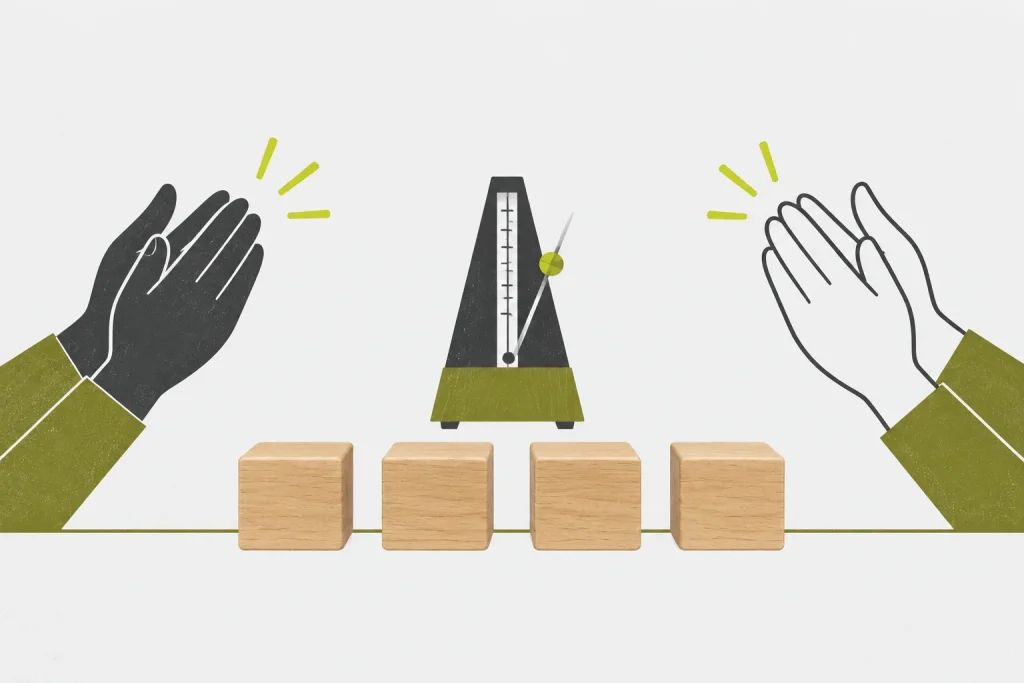

Learning how to match pitch means learning to reproduce one heard note with your voice or instrument. It is a comparison skill, not a test of whether you are “musical.” The useful question is simply: did your sound land below, above, or on the reference?
This five-minute exercise gives you one repeatable way to answer that question. You will hear a comfortable note, search gently, settle on it, and check the result without judging the sound of your voice.
Difficulty: beginner
Estimated time: five minutes
You need: a piano, keyboard, tuning app, pitch generator, or a person who can hold one comfortable note
Before you start: keep the sound comfortable
Choose a note that sits near the middle of your easy speaking or playing range. If you use your voice, make a light “mm,” “oo,” or “ah” at conversational volume. Do not push for a note that feels high, low, loud, tight, or breathless.
Stop if you feel pain, burning, persistent strain, or sudden hoarseness. The U.S. National Institute on Deafness and Other Communication Disorders recommends hydration, voice rest, and avoiding singing when the voice is hoarse or tired in its voice-care guidance. Persistent voice changes belong with a clinician, not a tougher exercise.
Quick overview
| Step | Action | Time |
|---|---|---|
| 1 | Hear one comfortable reference | 45 seconds |
| 2 | Hum from silence without chasing | 45 seconds |
| 3 | Slide toward the reference | 60 seconds |
| 4 | Settle and compare | 90 seconds |
| 5 | Repeat, then record one check | 60 seconds |
Step 1: Hear one reference clearly
Play a single steady note for two or three seconds. Let it stop. Hear the note once more before making your own sound.
Do not begin with a melody. One note keeps the task clear: remember one pitch, then reproduce it. Research with complete beginners treats pitch matching as a comparison between a reference and a produced tone, and shows that feedback can help learners adjust their response (Blanco, Tassani, and Ramirez, 2021).
Success check: you can hold the reference in attention for a moment after it stops. You do not need to name it.
Step 2: Make an easy first attempt
Take an unforced breath and hum the note you remember. Keep the attempt short—about two seconds—and return to silence.
Your first sound is information. If it misses, you have learned where the search starts. Avoid repeating the same unsupported guess at greater volume.
Tip: If using an instrument, choose a note you can sustain steadily. On piano, replay the note instead of trying to extend its decay.
Step 3: Search with a slow slide
Play the reference again. Begin your hum slightly below it if that is comfortable, then slide upward slowly. Listen for the moment when your sound and the reference seem to merge.
If you know you started above, reverse the direction. A slide turns a yes-or-no guess into a search path. It also helps separate pitch direction from vocal tone quality.
Keep the slide narrow. Large sweeps make it harder to notice the target and can tempt singers to force the range.
Step 4: Settle and listen for roughness
When you think you have reached the note, stop sliding and hold gently for one or two seconds. Two nearby pitches often create a noticeable wavering or rough pulse. As the pitches approach each other, that pulse slows; near a match, the combined sound feels steadier.
This acoustic cue is useful, but room sound, timbre, and volume can make it less obvious. A visual tuner may confirm the result after you listen. Let the ear make the first decision so the screen supports the skill instead of replacing it.
Success check: you can say “below,” “above,” or “close” before looking at the tuner. “Close” is a valid early result.
Step 5: Repeat with one recorded check
Complete three attempts on the same reference. After each attempt, pause and make one adjustment only: start a little higher, a little lower, or keep the same start and settle more carefully.
Record the fourth attempt on a phone and play it back once as a practical self-check. Compare the recorded attempt with the reference, then choose one adjustment for the next attempt: start higher, start lower, or keep the start and settle more carefully. Playback is a comparison aid, not a diagnosis of your voice or hearing.
Hear → Understand → Try: the five-minute drill
Hear
Listen to one reference twice. Notice its height without naming the note or judging its tone color.
Understand
Pitch height and voice quality are different. A breathy or plain sound can still match the target. Your job is to reduce the distance between two pitches, not to produce a polished singing tone.
Try
- Hum one easy attempt.
- Replay the reference.
- Slide toward it and settle.
- Decide below, above, or close.
- Check with a tuner or recording.
Finish line: complete three calm comparisons. A successful session means your adjustment became more informed, even if the last note was not exact.
Troubleshooting common pitch-matching problems
“I cannot tell whether I am high or low”
Ask a helper or tuner for the direction once, then repeat the same note while making a small change. You are training the link between the word, the movement, and the sound.
“My voice jumps past the note”
Slow the slide and reduce its range. Use “mm” at low volume, or switch to a comfortable instrument note for the comparison stage.
“I match for a moment, then drift”
Shorten the hold. Match for one second, release, and repeat. Stability is a separate skill from finding the pitch.
“A tuner says I am wrong even when it sounds close”
Check that the tuner is detecting your note rather than the reference speaker. Use headphones for the reference or alternate the two sounds instead of playing them together.
Frequently asked questions
Can anyone learn to match pitch?
Many beginners improve with clear references, manageable range, and feedback. Individual hearing, voice control, and instrument control differ, so progress is not uniform. If pitch perception or voice production remains unusually difficult, a qualified music teacher, audiologist, or speech-language pathologist can help identify the task that needs support.
Should I practise with a piano or an app?
Either works. Use the source that gives you a clean, stable pitch at a safe volume. A familiar instrument may be easier to repeat; an app can provide a visual check after your listening judgment.
How many notes should I use?
Start with one. When you can make useful high/low adjustments, add a second comfortable note a small distance away.
What should I practise next?
Place this drill inside the broader Hear–Compare–Respond ear-training method. Then use active listening for musicians to notice pitch direction inside real music.
Summary
To match pitch, hear one comfortable reference, make an easy attempt, slide toward the target, settle briefly, and compare. Keep the voice relaxed, use feedback after listening, and count a better-directed correction as progress.