Learning how to count beats in music means learning to keep a steady pulse, group it, and say where you are in the group. Start with four equal beats: 1 2 3 4. Do not add “and” counts until those four numbers remain even.
This five-step method works without an instrument. You need only a surface to tap and, optionally, a metronome.
Difficulty: Beginner
Estimated time: 10 minutes
Prerequisites: None; note values help but are not required
What you’ll need
- A hand or foot for the steady pulse
- Your voice for counting aloud
- A timer or metronome, optional
- A short recording with an obvious pulse, optional
Quick overview
| Step | Action | Time |
|---|---|---|
| 1 | Tap a steady pulse | 2 min |
| 2 | Group beats in fours | 2 min |
| 3 | Mark the start of each group | 2 min |
| 4 | Keep counting through silence | 2 min |
| 5 | Add even “and” subdivisions | 2 min |
Step 1: Find and maintain a steady pulse
Tap evenly and count eight taps without grouping them yet. Your goal is not speed. Your goal is equal spacing.
If you use recorded music, choose one recurring layer you can follow: a walking bass motion, a drum pulse, or another repeated event. The loudest event is not always the beat, so test your guess over several seconds.
Tip: Move a larger body part first. A gentle foot tap or hand motion makes drift easier to notice than counting silently.
Success looks like: the last four taps are approximately as evenly spaced as the first four.
Step 2: Group the pulse in fours
Now count:
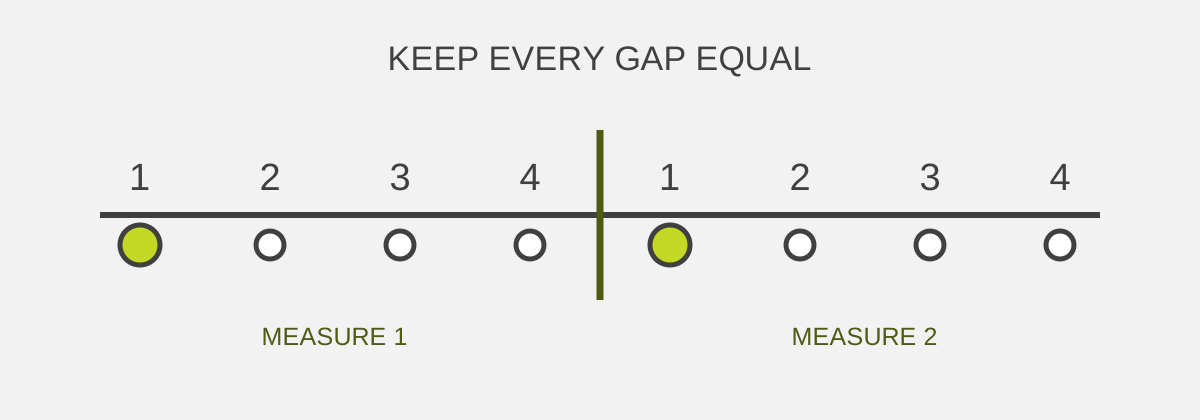
1 2 3 4 | 1 2 3 4
The vertical line represents the boundary between groups. In notation, a measure contains one metric group and bar lines separate measures. In simple meter, the top number of a time signature indicates how many beats are in each measure and the bottom number identifies the beat unit, as explained by Open Music Theory.
For this exercise, use four equal beats. Do not assume every piece uses groups of four; groups of two and three are also common.
Step 3: Make beat one easy to recognize
Say ONE slightly more firmly while keeping all tap intervals equal:
ONE 2 3 4 | ONE 2 3 4
You are marking position, not adding a longer delay before one. Beat one is the start of the count cycle. In real music, accents may appear elsewhere, so treat this as an orientation exercise rather than a rule that every first beat must sound loudest.
Warning: Do not rush from four back to one. The space between
4and the next1must match every other beat interval.
Step 4: Count through held sounds and rests
Make one clap on beat one, then keep tapping and counting silently or aloud through beats two, three, and four:
| Count | 1 | 2 | 3 | 4 |
|---|---|---|---|---|
| Pulse | tap | tap | tap | tap |
| Sound | clap | — | — | — |
Silence does not erase time. Neither does a long held sound. Keeping the count moving lets you enter accurately later.
Try the reverse: rest on one, then clap on two, three, and four. If you enter early, return to tapping alone.
Step 5: Add even subdivisions after the beat is stable
Place one evenly spaced “and” between each numbered beat:
1 & 2 & 3 & 4 &
Your foot still marks only the numbers. Your voice divides the space between those numbers into two equal parts. Simple meters divide each beat into two and then four equal parts; this is distinct from compound meters, which divide the beat into three.
Start with all eight spoken positions. Then clap a pattern, such as:
CLAP & 2 CLAP 3 & CLAP &
If the numbered taps become uneven, remove the claps but keep speaking all eight positions. The full lesson on rhythm subdivision develops this skill carefully.
Hear → Understand → Try
Hear
Listen to eight steady clicks or make eight taps. Notice whether you can predict the next one.
Understand
Counting names your position in a recurring group. The pulse supplies regular points; the numbers tell you which point you are on. “And” names the halfway position between adjacent beats in this simple-meter exercise.
Try
Count four measures in this order:
- One measure of
1 2 3 4 - One measure with claps on every number
- One measure with claps only on one and three
- One measure with no claps while the counting continues
Success check: you return to the next 1 after exactly four evenly spaced beats, including through the silent measure.
Practise recovery without restarting the measure
Counting is useful only if it helps you recover. Keep tapping 1 2 3 4, deliberately skip one clap, and re-enter on the next beat one. Do not squeeze an extra clap into the remaining space.
Next, begin counting from beat three: 3 4 | 1 2 3 4. This removes the habit of treating one as the only safe entry point. Success check: the next one arrives after two evenly spaced beats, not after a rushed reset.
Troubleshooting common issues
You rush from four back to one
Cause: You treat the bar line as a reset pause or anticipation.
Fix: Repeat 3 4 1 2 slowly and make all four spaces equal.
You lose the count during a rest
Cause: Your voice follows sound events instead of the underlying pulse.
Fix: Keep a quiet foot tap and speak the missing numbers before performing the rhythm.
“And” counts bunch beside the numbers
Cause: The beat has not been divided evenly.
Fix: Alternate hands: right hand on numbers, left hand on “and,” at a slower tempo.
Frequently asked questions
Does every song count 1 2 3 4?
No. Music may group beats in twos, threes, fours, or less regular patterns. Four is a useful first grid, not a universal rule.
Does each click always equal one beat?
Only if you assign it that role. A metronome click can represent a beat, a subdivision, or a larger span. Beginners should start with one click per beat.
Should I count while I play?
Count aloud while learning a rhythm, then move toward a quiet internal count. If speaking interferes with technique, clap or mime the passage first.
What should I learn next?
Use Note Values and Rests to connect counts to symbols, then practise rhythm subdivision before adding denser patterns.
Summary
Tap first. Group the pulse. Mark beat one without changing the spacing. Count through silence. Add subdivisions only when the numbered beats stay steady. That sequence turns counting from a string of numbers into a reliable map of musical time.