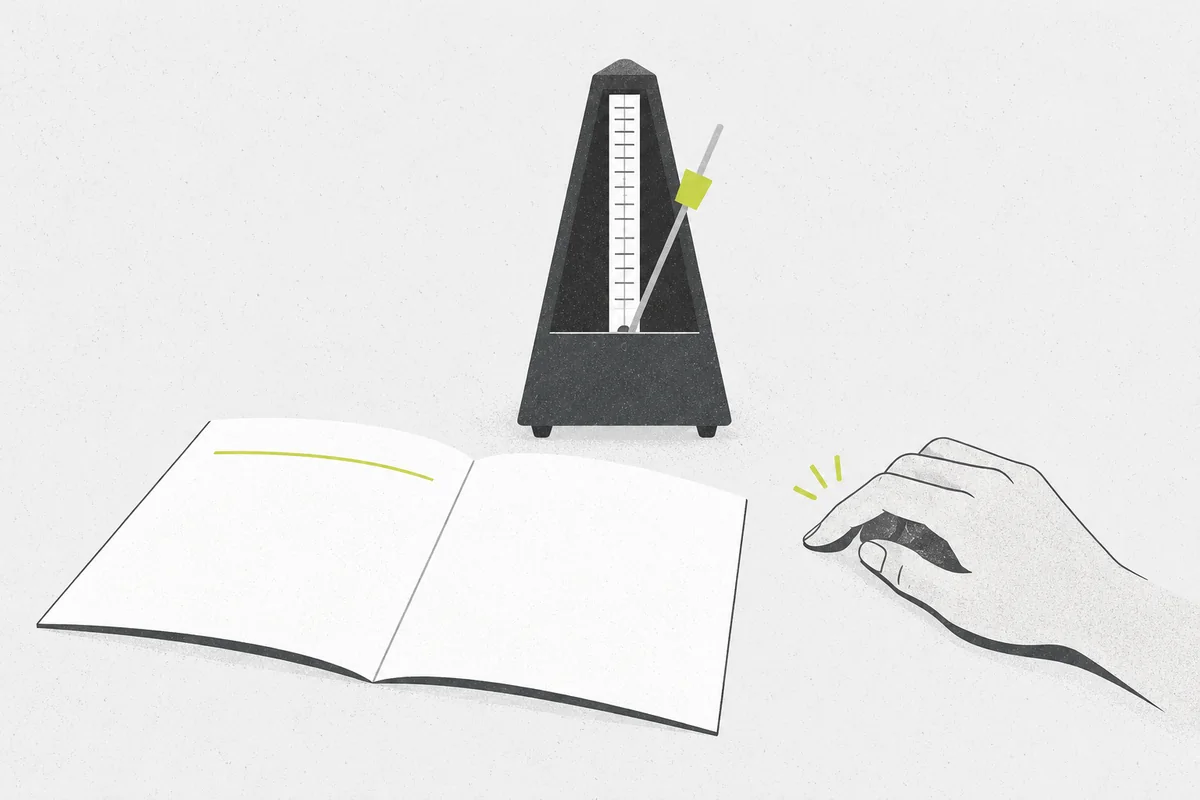
To learn how to use a metronome, stop treating every click as something to chase. First establish a steady motion in your body. Then let the click confirm the points you already expect. If you cannot predict the next click, reduce the task before reducing or increasing speed.
A metronome measures tempo in beats per minute (BPM). At 60 BPM, one designated beat occurs each second; Ableton’s beat-and-tempo lesson demonstrates the same BPM relationship. Your first goal is not to play a passage. It is to make one movement line up with a predictable click.
The listen → predict → join sequence below is Sounds Foundations’ editorial practice progression, not a claim that one fixed method suits every learner. It applies the source-backed distinction between a recurring beat and its tempo, then gives you a small action you can observe.
Difficulty: Beginner
Estimated time: 12 minutes
Prerequisites: Ability to tap four roughly even beats
What you’ll need
- A metronome app, hardware metronome, or click track
- A hand, foot, or comfortable body motion
- One note, chord, or silent instrument movement
- An optional recorder for checking drift
Quick overview
| Step | Action | Time |
|---|---|---|
| 1 | Listen without moving | 1 min |
| 2 | Build a body pulse | 2 min |
| 3 | Join the click | 2 min |
| 4 | Find a usable tempo | 2 min |
| 5 | Add one simple action | 3 min |
| 6 | Decide whether to repeat, slow, or increase | 2 min |
Step 1: Listen until you can predict the click
Choose a moderate setting, such as 60 BPM, and listen for eight clicks. Count 1 2 3 4 twice. Before moving, notice whether each click feels expected or surprising.
The click is an external reference. It cannot create a pulse inside your movement by itself. Prediction is the bridge: you hear the current click and prepare for the next.
Step 2: Build a body pulse without the metronome
Stop the device. Tap eight even beats with a relaxed hand or foot. Count aloud. Avoid a motion that causes tension or pain; the movement should be small enough to repeat comfortably.
Restart the metronome only after your own four-beat cycle is clear. This no-instrument step exposes whether the problem is pulse or instrument coordination. If the unaided taps drift, first use the pulse-building sequence in How to Improve Rhythm and Timing.
Tip: If your instrument occupies both hands, use a subtle foot motion, breath pulse, or head nod that does not disturb technique.
Step 3: Join the click instead of reacting to it
Listen for four clicks, then begin tapping on the next beat one. Continue for two measures.
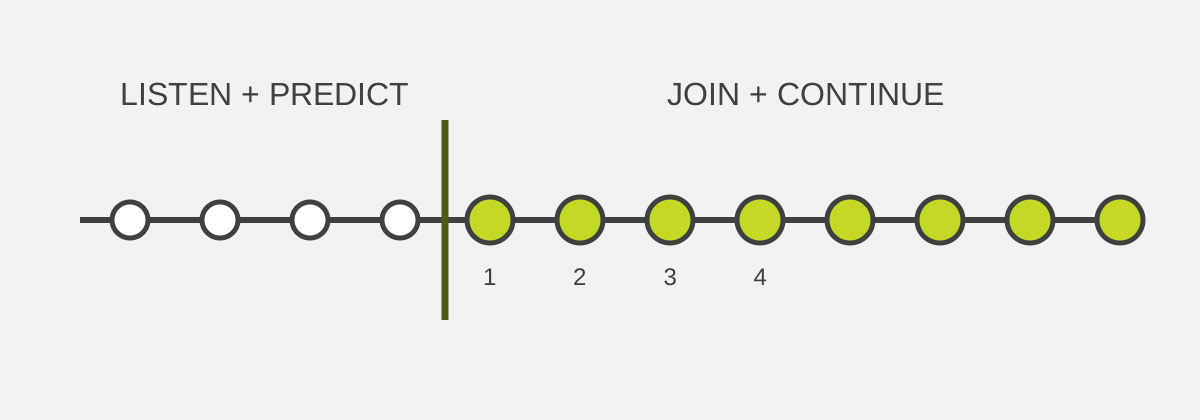
If your tap lands just after every click, you may be reacting rather than anticipating. Pause. Listen again. Prepare the movement so its contact point meets the click.
Do not worry if a perfectly aligned tap partly masks the click. Instead, watch for the pattern: do you repeatedly hear the click before or after your movement? That tells you the direction of the drift.
Step 4: Find a comfortable starting tempo
A usable starting tempo is one at which you can:
- anticipate the click rather than chase it;
- perform the chosen motion without tension;
- notice an early or late event;
- complete at least one short unit correctly.
There is no universal beginner BPM. An extremely low setting can be difficult because the gaps require more internal timekeeping. If 40 BPM feels like isolated clicks, try 60 BPM with a simpler action.
For a passage, remove pitch or fingering complexity first. Clap its rhythm, play one note, or mime the movement. Then choose a speed at which the smallest relevant motion stays organized. The broader slow-practice guide shows how to rebuild a passage.
Step 5: Add one simple musical action
Choose one action per click: one clap, one open-string stroke, one keyboard key, one sung syllable, or one chord change. Continue for eight clicks.
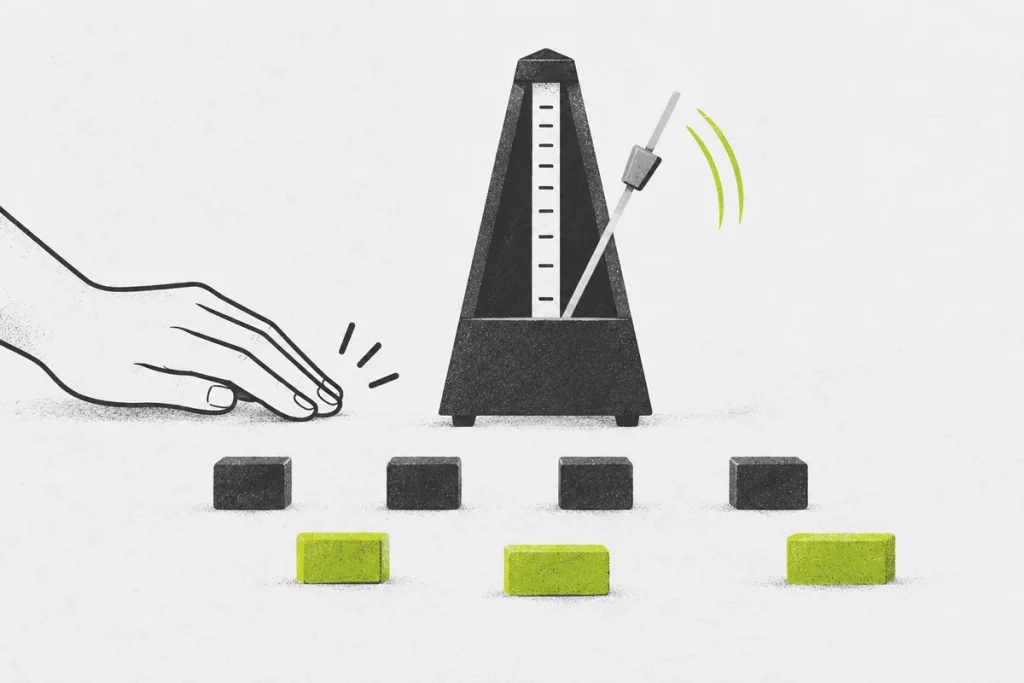
Then try a rhythm with sound on beats one and three while your foot taps all four beats:
| Count | 1 | 2 | 3 | 4 |
|---|---|---|---|---|
| Click/foot | x | x | x | x |
| Sound | x | — | x | — |
The metronome checks the pulse. It does not need to duplicate every event you play.
Warning: Do not add subdivisions, pitches, dynamics, and speed in the same attempt. Change one variable so you can identify the cause of an error.
Step 6: Use an explicit speed-change rule
After each short round, choose one response:
- Repeat at the same tempo if the result was correct but not yet predictable.
- Slow down or simplify if you missed the same position twice, tensed up, or could not tell whether you were early or late.
- Increase by 2–4 BPM only after three clean, relaxed repetitions in a row.
Do not increase speed after a lucky attempt. Do not increase when accuracy depends on holding your breath, squeezing, or ignoring a repeated mistake. A tempo increase is earned by repeatability, not by time spent.
Hear → Understand → Try
Hear
Listen to eight clicks at a comfortable tempo. Hear them as two groups of four.
Understand
The click marks a reference point. Your task is to predict that point and coordinate one simple action with it. A missed click is information about direction and consistency, not a failure.
Try
- Listen for four clicks.
- Tap the next eight clicks.
- Continue tapping for four silent imagined clicks after stopping the device.
- Restart it and compare your tap with the returning click.
Success check: you rejoin within roughly one beat and can say whether you drifted faster or slower. The exercise is diagnostic; exact re-entry develops over time.
Troubleshooting common issues
The click seems to disappear
If your sound masks the click, lower your instrument volume or use a different click timbre. A disappearing click can also mean close alignment, but confirm by recording rather than assuming.
You get lost after one mistake
Keep counting and re-enter on the next beat one. Practise recovery separately: intentionally skip one event while the foot and count continue.
Slow settings feel harder
Use two clicks per beat temporarily, or choose a moderate BPM and assign the click to the subdivision. Return to one click per beat once the spacing is internal.
You can clap it but not play it
The pulse is probably not the only issue. Reduce the instrument movement, isolate a transition, or use the feedback loop in How to Practice an Instrument Effectively.
Frequently asked questions
Should beginners always practise with a metronome?
No. Use it when you need timing feedback. Also practise without it so you learn to maintain and express time independently. Music that intentionally changes tempo or uses rubato should not be flattened into one rigid speed.
What BPM should I start at?
Choose the speed at which you can predict the click, stay relaxed, and complete the smallest practice unit accurately. That may differ by task.
Should every note line up with a click?
No. Notes may occur between clicks or last across several clicks. Begin with one click per beat, then learn subdivision.
When should I stop using the metronome?
After a checked round, turn it off and reproduce the same pulse. Record the result, then return to the click for comparison. This prevents dependency.
Summary
Listen, predict, join, and simplify. Use the click as feedback, not as a moving target. Increase tempo only after three clean, relaxed repetitions; otherwise repeat or reduce the task. That rule makes metronome practice measurable and calm.