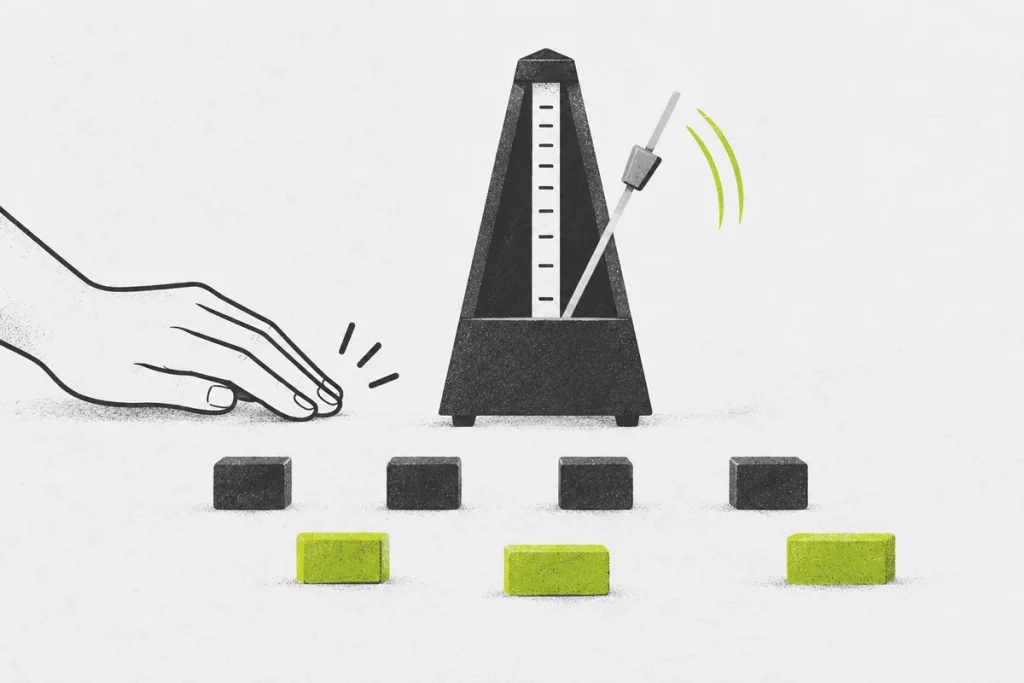
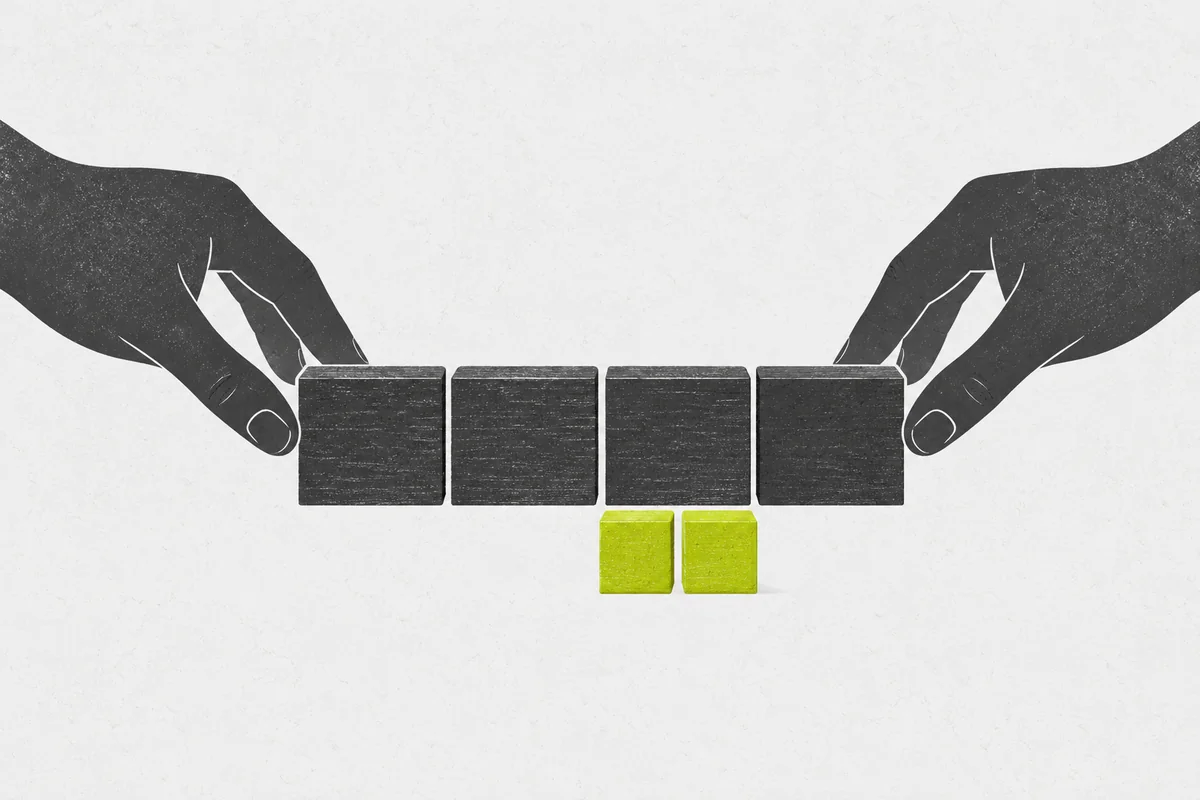
Rhythm subdivision for beginners starts with one steady beat and divides the space inside it into equal parts. Two equal parts give you the basic eighth-note grid in simple meter. Four equal parts give you the sixteenth-note grid. Three equal parts can form a triplet in simple meter.
Subdivision is not “playing faster” at random. The main beat remains steady while you place an even internal grid between beats.
Difficulty: Beginner
Estimated time: 12 minutes
Prerequisites: Count 1 2 3 4 evenly for four measures
What you’ll need
- One hand or foot to mark the main beat
- Your voice to speak subdivisions
- A metronome at a comfortable tempo, optional
- A recording device, optional
Quick overview
| Step | Action | Spoken grid |
|---|---|---|
| 1 | Hold four main beats | 1 2 3 4 |
| 2 | Divide each beat in two | 1 & 2 & 3 & 4 & |
| 3 | Perform selected positions | numbers and selected “ands” |
| 4 | Divide each beat in four | 1 e & a |
| 5 | Contrast three equal parts | 1 trip let |
Step 1: Make the main beat visible
Tap and count 1 2 3 4 repeatedly. The main beat must remain easier to feel than the smaller parts you will add.
If you cannot maintain four even beats, pause here and use How to Count Beats in Music. Subdivision magnifies an unstable pulse; it does not repair one automatically.
Step 2: Divide every beat into two equal parts
Keep your foot on the numbers and speak and exactly halfway between them:
1 & 2 & 3 & 4 &
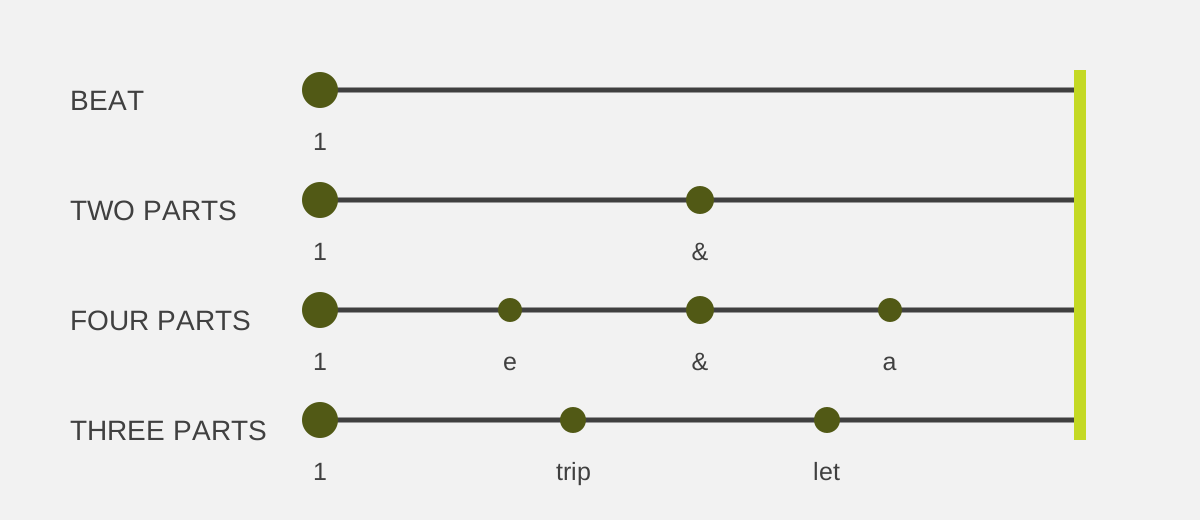
The time from 1 to & must equal the time from & to 2. Open Music Theory describes simple meter as a beat divided into two and further subdivided into four.
Tip: Alternate hands: right on each number, left on each
&. Keep both motions small and equal.
Step 3: Keep the full grid while performing fewer events
Continue speaking all eight positions, but clap only on 1, the & after two, and 4:
| Position | 1 | & | 2 | & | 3 | & | 4 | & |
|---|---|---|---|---|---|---|---|---|
| Speak | x | x | x | x | x | x | x | x |
| Clap | x | — | — | x | — | — | x | — |
The silent positions still exist in your internal grid. This is why full-grid counting helps: it makes off-beat entrances measurable.
Success looks like: the foot remains even, and the off-beat clap sits halfway between beats two and three.
Step 4: Divide each beat into four equal parts
At a slower tempo, speak:
1 e & a 2 e & a 3 e & a 4 e & a
The syllables are labels for four equal positions. Your foot remains on the numbers. Do not accent every spoken syllable equally strongly; let the numbered pulse remain easy to find.
Start with one beat at a time:
- Tap beat one.
- Speak
1 e & aevenly before beat two. - Stop and check whether the next numbered beat arrived where expected.
- Expand to two beats, then one full measure.
Warning: If
e & asounds like three quick syllables attached to the next number, slow down. Four parts means three internal points with equal gaps, not a burst after the beat.
Step 5: Contrast two parts with three parts
In simple meter, a triplet divides a beat into three equal parts. Speak 1-trip-let 2-trip-let while tapping on the numbers. Open Music Theory’s rhythmic essentials lesson distinguishes a triplet’s three-part division from the normal two-part division of simple meter.
Do not try to squeeze triplets into the 1 & grid. They are a different division of the same beat:
- Two parts:
1 & - Three parts:
1 trip let - Four parts:
1 e & a
Practise two measures of one division before switching. Keep the numbered beat unchanged.
Hear → Understand → Try
Hear
Tap four steady beats. Between each pair, imagine a midpoint even before you speak it.
Understand
Subdivision creates smaller reference points without changing the main tempo. You are increasing the resolution of the timing grid.
Try
- Count one measure of quarter-note beats.
- Count one measure of eighth-note subdivisions.
- Clap only on each
&while the foot stays on numbers. - Return to numbers alone without changing the foot speed.
Success check: every clap falls halfway between two foot taps, and the transition back to numbers does not speed up or slow down.
Repeat the same sequence on three separate practice days. Begin from numbered beats each time instead of assuming yesterday’s subdivision is still even.
Troubleshooting common issues
The subdivisions make the beat faster
Cause: You are treating each spoken syllable as a new main beat.
Fix: Keep a larger foot motion on numbers and a smaller hand motion on subdivisions.
Off-beat claps pull the foot
Cause: Both movements are coupled.
Fix: Speak the off-beat first. Then add one clap per measure before filling the pattern.
Triplets sound uneven
Cause: You are reusing the duple midpoint.
Fix: Use three neutral syllables of similar length and record one beat repeated several times.
Frequently asked questions
Are subdivisions always notes?
No. Subdivision is the timing grid. A note or rest may occupy one or several positions, and some positions may contain no new event.
Do I need one counting system forever?
No. Numbers with &, e, and a are common for simple subdivision, but other systems can work. Consistency within an exercise matters more than loyalty to one vocabulary.
How fast should I practise?
Use a tempo at which every smaller part stays even and your main beat remains obvious. If you cannot hear the placement, slow or simplify.
What comes next?
Connect the grid to written durations in Note Values and Rests and to beat grouping in Time Signatures for Beginners. To practise recognizing and copying these patterns without notation, continue with rhythm ear training.
Summary
Keep the beat visible. Divide it evenly into two before four, and contrast three-part division only after the pulse is secure. Perform selected positions while continuing to imagine the full grid. That is the practical foundation of rhythmic accuracy.