Here are notes, scales, and chords explained as one connected system. A note names a pitch. An interval describes the distance between two notes. A scale arranges a chosen collection of notes in order. A chord combines selected notes, usually sounding together.
You do not need four separate theories. Follow one collection—C, D, E, F, G, A, B—and watch each idea answer a different question.
The short answer
| Building block | What it does | C-major example |
|---|---|---|
| Note | Identifies one pitch position | C |
| Interval | Compares two notes | C up to E is a third |
| Scale | Orders a pitch collection | C D E F G A B C |
| Chord | Combines selected notes | C E G forms a C major triad |
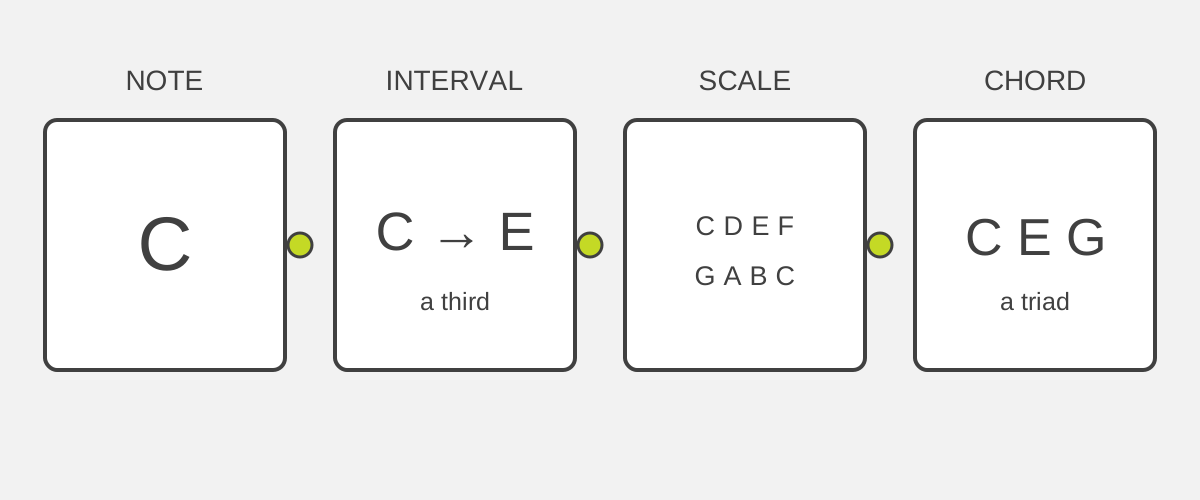
The same notes can take different roles. C is one note; C–E is an interval; C within the ordered C-major scale is scale degree one; C–E–G together form a triad.
Notes give pitches usable names
Pitch is how high or low a sound seems. In common Western notation, note names use the letters A through G, repeated in higher and lower octaves. Sharps and flats adjust written pitch positions and preserve musical spelling.
A note name does not tell you everything. It does not by itself tell you duration, loudness, instrument, or function. It gives you an identity that can be compared and organized.
For this article, use the natural-note collection from C to the next C:
C D E F G A B C
That collection lets us build the next three ideas without changing examples.
Intervals compare two notes
An interval is the distance between two pitches. It can be melodic, with the notes sounded in sequence, or harmonic, with them sounded together. Open Music Theory stresses that intervals are both written and aural relationships.
Count both letter names to find the generic interval number:
- C to D: C(1), D(2) → second
- C to E: C(1), D(2), E(3) → third
- C to G: C(1), D(2), E(3), F(4), G(5) → fifth
Accidentals affect interval quality but not that generic letter count. Learn the number first, then add quality in Music Intervals for Beginners.
Scales order a collection
A scale is an ordered pitch collection. Ascending C major is:
C D E F G A B C
The major-scale pattern is whole, whole, half, whole, whole, whole, half, as documented in Open Music Theory’s major-scales chapter. The pattern matters because it preserves the interval relationships when the scale starts on another note.
Scales are maps, not finger drills alone. They show which notes belong to a collection, where half steps occur, and how scale degrees can support melodies and chords. The guide What Are Scales in Music? develops those uses.
Chords combine selected notes
A chord combines notes. A triad is a three-note chord whose notes can be arranged in thirds. Choose alternating notes from C major starting on C:
C — E — G
From C to E is a third; from E to G is another third. Together they form a C major triad. Open Music Theory defines triads as three-note chords whose notes can be stacked in thirds and names their compact parts root, third, and fifth in its triads lesson.
Not every chord must come from one major scale, and not every chord is a triad. This example is a clean starting model, not the boundary of harmony.
One collection, four views
Use C major to see the hierarchy:
- Point: choose the note C.
- Distance: compare C with E; the generic distance is a third.
- Collection: place C and E inside C D E F G A B.
- Combination: add G and sound C E G together as a triad.
The arrow is not one-way. A chord can be broken into intervals. A melody can outline a chord one note at a time. A scale can help you name the surrounding pitch collection.
Why sequence and simultaneity change the job
The labels describe relationships, not merely how many notes appear. C–E–G played one after another can outline a C-major chord as an arpeggio; played together, the same pitch classes form a harmonic chord. C–D–E played in order is a scale fragment, while C and E alone define an interval.
Ask what the notes are doing:
- Comparing two points? Name the interval.
- Moving through an ordered collection? Identify the scale or scale fragment.
- Acting as one harmonic unit? Identify the chord.
This decision rule prevents “three notes equals chord” and “several rising notes equals scale,” two shortcuts that fail outside the simplest examples.
Hear → Understand → Try
Hear
On any pitched instrument or virtual keyboard, play C, then E, then G separately. If those notes are not practical on your instrument, choose the first, third, and fifth notes of one familiar major scale.
Understand
Each sound is a note. Each pair creates an interval. The ordered set belongs to a scale. Sounding the three selected notes together, where possible, creates a triad.
Try
- Play or sing C–D–E slowly.
- Return to C and play C–E.
- Play the full C-major collection up and down.
- Play C–E–G separately, then together if your instrument allows.
Success check: you can point to each stage and say “note,” “interval,” “scale,” or “chord” without changing the example.
Common beginner questions
Is a note the same as a pitch?
In everyday teaching they often overlap. More precisely, pitch is the perceived highness or lowness of sound, while a note is a named or notated musical event. That distinction becomes useful when discussing tuning, octaves, and spelling.
Is every group of notes a scale?
No. A scale is an ordered collection with a defined pitch structure. A random list is not automatically a scale.
Is every group of three notes a triad?
No. In common tonal theory, a triad is a three-note chord that can be arranged as stacked thirds. Other three-note collections exist.
Do chords always use adjacent scale notes?
No. Basic triads select alternating scale degrees: one, three, and five. Adjacent notes can form other kinds of sonority.
What to learn next
Study music intervals if distances remain unclear. Learn major and minor triads if you are ready to change chord quality. Then connect chords over time with Chord Progressions for Beginners.
Keep one sentence nearby: notes are points, intervals are distances, scales are ordered collections, and chords are combinations.