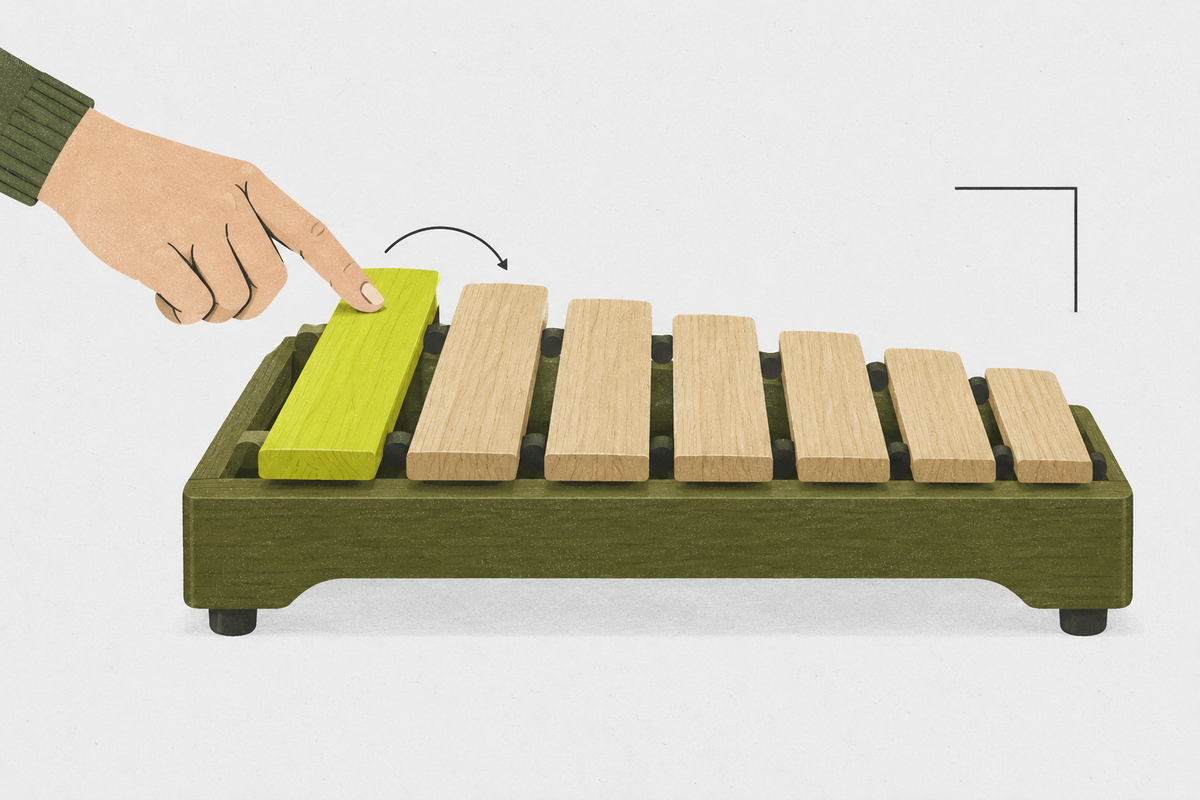
What are scales in music? A scale is an ordered collection of pitches. When you play or sing those pitches from low to high or high to low, you hear the collection’s step pattern and its relationship to a starting note.
That is more useful than thinking of a scale as a compulsory finger drill. A scale can be a pitch map, an ear-training pattern, a source for melodies, and a way to practise coordinated movement. It does not explain every note in every kind of music.
This guide begins with the major scale used in common Western tonal practice. Other musical traditions organize pitch differently, and even Western music includes chromatic, modal, atonal, and changing-key contexts.
The short answer: why learn music scales?
Learn a scale when it helps you connect four things:
- Sound: how neighboring pitches and the return to a home note feel in context.
- Structure: the order of whole steps and half steps.
- Location: where those pitches are on your voice or instrument.
- Use: how a melody, chord, or improvisation selects and rearranges them.
You do not need to memorize every scale before making music. Begin with one scale that appears in music you are learning, then use it in more than one way.
A scale is an ordered collection, not just an exercise
The word ordered matters. C–D–E–F–G–A–B is the pitch collection of C major in ascending order. Rearrange those notes into E–G–C and you still use pitches from C major, but you are no longer playing the scale in order; you have made a different musical object.
The distance from one pitch to the next is an interval. A half step is the smallest standard step on a piano keyboard from one key to the next, including black or white keys. A whole step equals two half steps. On other instruments, the physical distance and fingering differ, so use an instrument-specific chart or teacher when needed.
An octave connects two notes with the same letter name at a higher or lower register. The upper C completes the one-octave C-major scale:
| Scale degree | 1 | 2 | 3 | 4 | 5 | 6 | 7 | 8 (1) |
|---|---|---|---|---|---|---|---|---|
| Note in C major | C | D | E | F | G | A | B | C |
| Step from previous note | — | whole | whole | half | whole | whole | whole | half |
The number describes a note’s position relative to the scale’s starting note. Scale degree 1 is often called the tonic in this tonal context. Degree 8 repeats that tonic an octave higher.
How the major-scale pattern works
The ascending major-scale formula is:
whole – whole – half – whole – whole – whole – half
Open Music Theory’s major-scale chapter defines the same ordered pattern and explains scale-degree numbers, solfège, and key signatures. The pattern remains the same when the starting note changes, though the note spellings and instrument positions change.
On a keyboard, C major is visually simple because it uses the white keys from C to C. That makes C a convenient example, not the natural or easiest scale for every instrument. A guitarist, singer, clarinetist, or brass player may find another starting pitch more comfortable.
A key is broader than a scale. A scale lists an ordered pitch collection; a key describes a tonal context in which pitches and harmonies relate to a tonic. Some pieces move between keys, blur the tonic, use modes, or avoid a stable key altogether. Knowing a scale gives you a map, not a full analysis.
Hear → Understand → Try: map one octave
Use a comfortable major scale your instrument can produce safely. Use C major if it is convenient; otherwise keep the degree numbers and substitute the correct notes for your chosen key.
Hear
Play or listen to the scale once ascending and once descending. Do not race. Notice where adjacent notes seem closer together and how the last note resembles a return at a new height.
Then hear only 1–2–3–2–1. The short pattern gives the scale a center instead of presenting eight unrelated notes.
Understand
The whole/half-step sequence builds the major scale. The degree numbers let you carry the same relationships into another key without pretending the note names stay the same.
In C major:
- 1–2–3–2–1 is C–D–E–D–C.
- 1–3–5–3–1 is C–E–G–E–C.
- 5–4–3–2–1 is G–F–E–D–C.
These are pitch-order examples, not written rhythms. Give each note one even pulse for the first attempt.
Try
- Play or sing degrees 1–2–3–4–5–6–7–8 slowly.
- Descend 8–7–6–5–4–3–2–1 without pausing at the turn.
- Speak the degree numbers as you play, or speak them in a separate pass if coordination is difficult.
- Play 1–2–3–2–1 three times on an even pulse.
- Create a four-note phrase using only degrees 1, 2, and 3. End on 1.
- Change the rhythm while keeping the pitch order.
Success check: you can begin on 1, reach the octave without losing the pitch order, return to 1, and play your three-degree phrase twice with the same notes. Speed is not part of the check.
If you cannot sing the range comfortably, use an instrument or move the starting pitch. If the fingering causes tension or uncertainty, stop and consult instrument-specific guidance.
What scales help you hear, understand, and play
Hear pitch relationships
Scale degrees give your ear a reference. Instead of hearing an isolated E, you can hear degree 3 relative to C in a C-major context. The beginner ear-training loop shows how to compare and reproduce those relationships.
Understand melody and harmony
Melodies often select, repeat, skip, and decorate scale pitches. Chords can be built from combinations of pitches within a scale, though pieces also borrow or alter notes. The guide to how chord progressions work continues from individual degrees into harmony.
Learn your instrument’s geography
Repeating one pitch order across registers can reveal fingering patterns, string crossings, breath changes, hand shifts, and note locations. Those physical benefits depend on appropriate technique. “Correct scale fingering” is instrument-, key-, and context-specific rather than one universal rule.
Connect keys and notation
Major keys use key signatures to represent their usual sharps or flats in conventional staff notation. You can learn the sound and instrument pattern before mastering the signature, then connect them through the beginner sheet-music method.
Make and vary musical phrases
A scale supplies options; it does not write the phrase for you. Limit yourself to three degrees, change the order, add a rest, or repeat one pitch. Constraint turns the scale from a recitation into material.
How to practise scales without empty repetition
Use one clear target per set. For example:
- Even time: one pitch on each steady pulse.
- Pitch accuracy: stop and compare only after the full ascent or short fragment.
- Tone: keep volume and attack consistent through one comfortable octave.
- Coordination: prepare the turn or shift without increasing tension.
- Hearing: sing or imagine the next degree before playing it.
- Application: find three scale notes in a piece or create a phrase.
Change only one variable at a time. If you vary rhythm, articulation, octave, and tempo together, you will not know what caused improvement or instability.
A metronome can check spacing after you can play the order slowly. Begin at a pace where you prepare each movement. The feedback-led practice routine explains how to set a target and adjust after each attempt.
Major, minor, pentatonic, and modes: what comes next
The natural minor, harmonic minor, and melodic minor scales differ from each other; “the minor scale” is not one unchanging pattern. Open Music Theory’s minor-scale guide maps those distinctions.
Major is sometimes associated with brightness and minor with sadness in familiar Western contexts, but those associations are not definitions or universal laws. Research comparing groups with different exposure to Western music found that the familiar major-happy/minor-sad response varied with exposure; the PLOS ONE study does not justify a simple universal rule.
Pentatonic scales use five pitch classes per octave and appear in many distinct musical traditions. Modes reorder or alter interval relationships around a tonal center. Learn either when the music you want to play gives it a purpose.
Common questions
How many scales should a beginner learn?
Enough to support current music while keeping the pattern accurate and physically comfortable. One scale used for listening, technique, notation, and phrase making is more useful than many memorized only as finger sequences.
Should I always practise scales with a metronome?
No. First confirm the pitch order and movement. Add a click when timing is the variable you want to test; remove it when you need to listen closely to tuning, tone, or physical preparation.
Do I need to sing scales?
No. Singing can connect hearing and response, but an instrument, scale-degree labels, and careful listening can serve learners who cannot or prefer not to sing.
Your next step
Play one comfortable scale slowly, name its degrees, and create one four-note phrase that returns to 1. That completes a cycle from pattern to musical use.
Review the practical map of music theory for beginners if whole steps, intervals, or keys need more context. Browse the Notes, Scales & Chords path when you are ready to connect the pitch map to harmony.