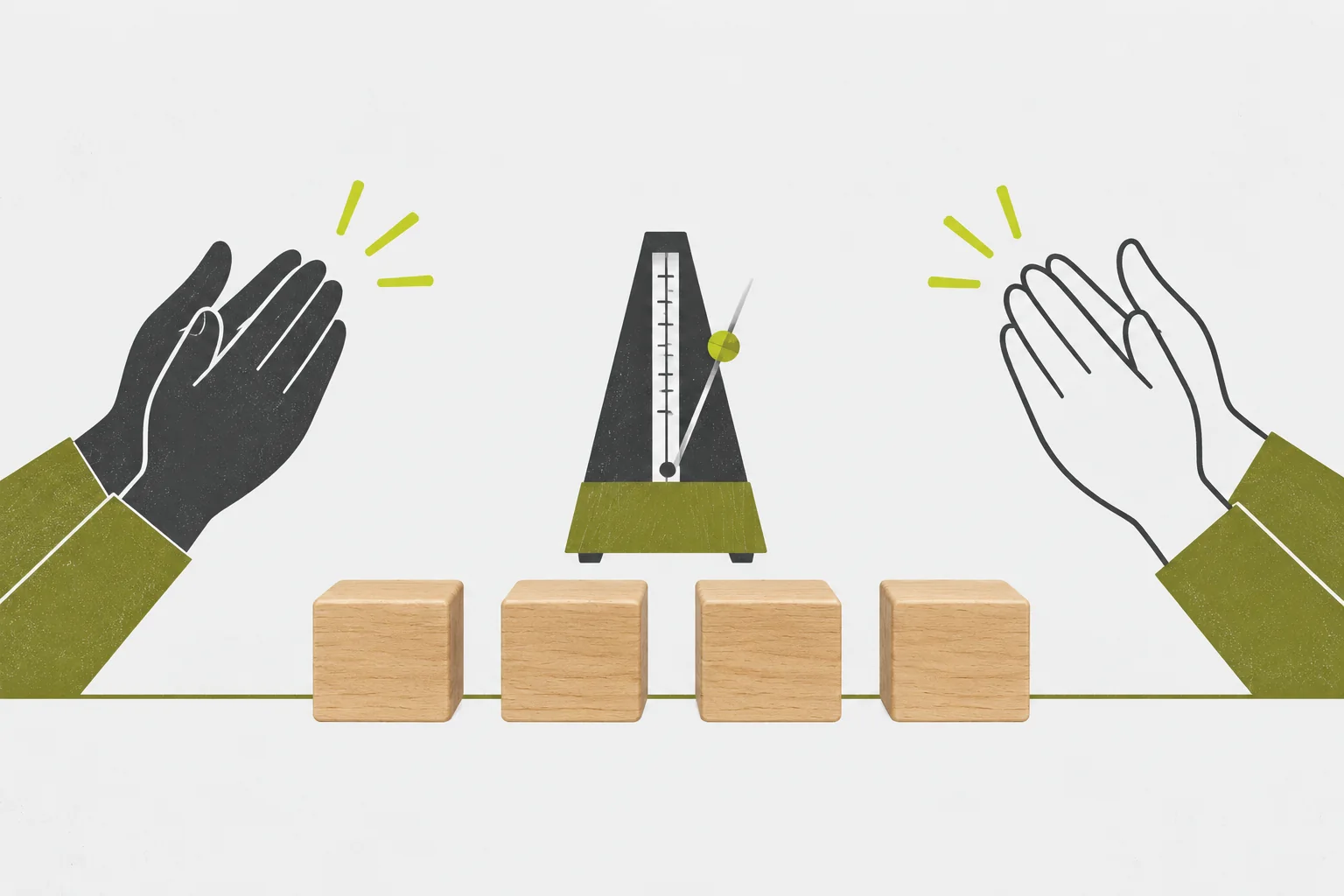
The most useful beginner rhythm ear training exercises do not begin with notation. They begin with a steady pulse, a short pattern, and a copy you can compare with the model.
This routine uses four-beat call and response. You will keep the beat moving, notice where sounds and silences occur, clap the pattern back, and correct one difference at a time.
Difficulty: beginner
Estimated time: 10 minutes
You need: your hands or a quiet tapping surface, plus a helper or a recording device
Separate pulse from pattern
Pulse is the steady underlying beat. Rhythm is the arrangement of sound and silence across that beat. A pattern can change while the pulse stays steady.
Rhythm perception and movement are closely linked. Producing rhythm involves using perceived timing to guide coordinated movement (Martins et al., 2023). That is why the exercise keeps one body pulse running while the clap pattern changes.
Quick overview
| Step | Action | Time |
|---|---|---|
| 1 | Establish four steady beats | 1 minute |
| 2 | Hear one two-beat call | 2 minutes |
| 3 | Copy while the pulse continues | 2 minutes |
| 4 | Compare sound and silence positions | 2 minutes |
| 5 | Mix four patterns and record | 3 minutes |
Step 1: Establish four steady beats
Tap your foot or pat one leg at a comfortable walking pace. Count 1, 2, 3, 4 aloud. Continue for four cycles without speeding up.
Do not choose a challenging tempo. The pulse is the ruler used to compare patterns. If the ruler bends, you cannot tell whether the pattern changed or the timing base changed.
Success check: four groups of four feel equally spaced, and beat one is clear without being louder every time.
Step 2: Hear one two-beat call
Keep tapping the pulse. Have a helper clap one of these two-beat patterns, or record them yourself with a count-in:
- one clap on beat one, silence on beat two;
- silence on beat one, one clap on beat two;
- one clap on each beat;
- two even claps within beat one, one clap on beat two.
Listen without copying the first time. Ask: how many claps occurred, and where did the silence fall?
Step 3: Copy after a one-beat gap
Hear the call, leave one silent beat, then clap it back. Keep the foot or leg pulse moving through the gap.
The gap matters. It makes you retain the pattern briefly instead of moving at the same time as the model. Call-and-response is also used in formal pitch and rhythm training because it links perception with production (Frischen et al., 2019).
Tip: Say
tafor a clap andrestsilently for no clap. The inner label can hold the place of a silence without filling it with sound.
Step 4: Compare one feature at a time
After each response, check in this order:
- Did the pulse continue?
- Did you make the correct number of claps?
- Did each clap land in the correct beat?
- If there were two claps in one beat, were they even?
This sequence prevents a vague “wrong” judgment. Feedback becomes usable when it identifies the next adjustment. Recent music-learning research likewise emphasizes actionable feedback that learners can apply during independent practice (McPherson, 2025).
Step 5: Mix four patterns and record
Create four calls, each lasting two beats. Leave two beats of steady pulse between them. Record the complete sequence.
Play it back and respond to each call. Then listen once more while following both the model and your copy. Mark each item:
- P if the pulse changed;
- C if the clap count changed;
- L if a clap landed in the wrong location;
- E if an even subdivision became uneven.
Success check: copy three of four patterns while the pulse continues, and classify any miss with one letter.
Deterministic timing strip
The strip below is text, not generated notation. Each box is one equal beat. X means clap; — means keep the beat silent.
| Pattern | Beat 1 | Beat 2 | Spoken cue |
|---|---|---|---|
| A | X | — | clap, rest |
| B | — | X | rest, clap |
| C | X | X | clap, clap |
| D | X X | X | two-even, clap |
For pattern D, fit two equally spaced claps inside the first beat. Keep the beat boxes the same length.
Hear → Understand → Try: a 10-minute loop
Hear
Listen for the number and position of events. Keep a quiet body pulse instead of chasing each clap.
Understand
The pulse provides equal time units. The rhythm tells you which units contain sound, silence, or a subdivision.
Try
Copy four two-beat calls after a gap. Record the final set and classify any mismatch as pulse, count, location, or evenness.
Finish line: three accurate copies and one specific note about the remaining problem.
Troubleshooting
“I copy immediately instead of waiting”
Make the response gap audible by counting one extra beat aloud. Later, count it silently.
“My foot stops during rests”
Practise pattern A alone. The clap stops, but the body pulse continues through beat two.
“Two claps turn into a rush”
Alternate hands and say one-and evenly. Return to one clap per beat if the main pulse changes.
“I remember the claps but start on the wrong beat”
Add a spoken count-in: one, two, ready, hear. Stable entry points are part of rhythm, not an optional extra.
Frequently asked questions
Should I use a metronome?
You may use a quiet click after you can tap four steady beats alone. It should reveal drift, not compete with the call.
When should I add longer patterns?
Move from two beats to four when you can retain the short calls and keep the response gap. Add length before adding many new subdivision types.
Do I need notation?
No. Listening and copying can stand alone. Later, rhythm subdivision for beginners can connect the heard pattern to counted symbols.
What if rhythm feels harder than pitch?
Train it separately. The pulse-first rhythm guide builds the underlying beat before adding patterns.
Summary
Keep one steady pulse, hear a short call, wait, copy, and compare a single feature. Short patterns and specific feedback make rhythm ear training measurable without turning it into a long test.