Music intervals for beginners become manageable when you identify two layers in order. First count the generic interval number from one letter name to the other, including both endpoints. Then identify the quality—major, minor, perfect, augmented, or diminished.
Start with number. C to E is some kind of third because C–D–E spans three letter names. Whether it is major or minor depends on the exact pitch spacing. If the surrounding vocabulary is still separate in your mind, first see how notes, intervals, scales, and chords fit together.
Difficulty: Beginner
Estimated time: 15 minutes
Prerequisites: Know the musical letters A through G
What you’ll need
- A pitched instrument, keyboard app, or voice
- Paper for writing two note names
- The checked interval diagram below
- Optional recording for comparison
Quick overview
| Step | Action | Example |
|---|---|---|
| 1 | Choose two notes | C and E |
| 2 | Count letters inclusively | C(1), D(2), E(3) |
| 3 | Name the generic size | third |
| 4 | Compare exact spacing | C–E is a major third |
| 5 | Hear and reproduce | play C, then E |
Step 1: Treat an interval as a relationship
An interval needs two pitches. Play C and E separately: that is a melodic interval. Play them together: that is a harmonic interval. The relationship can be named in either form.
Open Music Theory’s interval chapter defines intervals as distances between pitches and emphasizes both their written and aural forms.
Step 2: Count letter names inclusively
Count the starting and ending letter:
- C to C = unison, or one
- C to D = second
- C to E = third
- C to F = fourth
- C to G = fifth
- C to A = sixth
- C to B = seventh
- C to the next C = octave, or eight
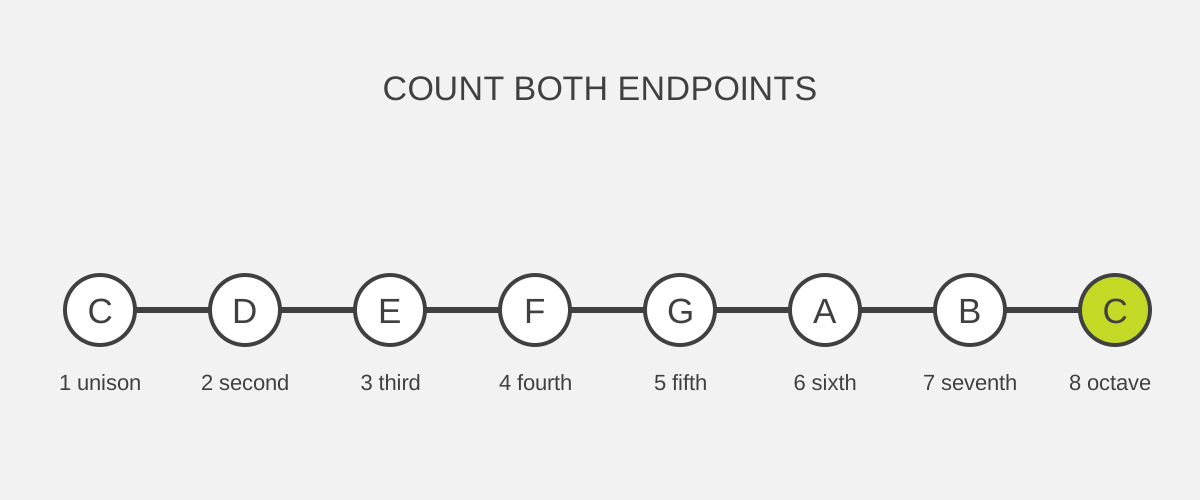
The accidental does not change the generic number. C to E, C to E-flat, and C-sharp to E are all some kind of third because the letter span remains C–D–E.
Tip: Say the letters and numbers together:
C one, D two, E three.
Step 3: Learn which sizes use major/minor or perfect
Interval quality makes the generic size specific:
- Unisons, fourths, fifths, and octaves use perfect as their basic quality.
- Seconds, thirds, sixths, and sevenths use major or minor.
- Any interval can become augmented or diminished in the appropriate spelling and context.
For a first pass, focus on major, minor, and perfect. Avoid memorizing a large semitone table before the letter-counting method is stable.
Step 4: Compare with the major scale from the lower note
One standard method is to imagine the major scale beginning on the lower note. If the upper note belongs to that major scale:
- unison, fourth, fifth, or octave is perfect;
- second, third, sixth, or seventh is major.
For C to E, the C-major scale contains E, so the interval is a major third. Lower E to E-flat while keeping C: the generic size is still a third, but it is now a minor third.
For C to G, G belongs to C major and fifths use the perfect family, so C–G is a perfect fifth.
Warning: Keyboard distance alone cannot tell you correct spelling. C–E-flat and C–D-sharp can sound the same in equal temperament but have different generic numbers and theoretical names.
Step 5: Hear, sing, and check one interval
Play C, pause, then play E. Listen to the size and direction before naming it. Sing or reproduce the second pitch if comfortable, then check with the instrument.
Do not use a familiar-song mnemonic as proof. Songs can help recall a sound, but context, tuning, and scale degree can change perception. Use the written count and an instrument check together.
Hear → Understand → Try
Hear
Play C–D, then C–E, then C–G as separate ascending pairs. Let each pair finish before the next.
Use a tuner only to confirm pitch, not to replace attentive listening.
Understand
The second pair reaches farther than the first; the third reaches farther again. The generic numbers—second, third, fifth—name the inclusive letter spans.
Try
- Write A and C.
- Count A(1), B(2), C(3): a generic third.
- Play A to C and listen.
- Play A to C-sharp and compare.
Success check: you identify both as thirds before naming A–C a minor third and A–C-sharp a major third.
Common mistakes and fixes
Counting the gap instead of both notes
Symptom: C to E is called a second.
Fix: Include the starting note: C(1), D(2), E(3).
Naming quality before size
Symptom: Accidentals cause you to lose the letter span.
Fix: Cover the accidental, count letters, then reveal it and determine quality.
Assuming higher always means larger
Symptom: You compare register instead of the nearest stated pitches.
Fix: Write or play the exact two pitches and specify direction.
Treating semitone count as the whole name
Symptom: Enharmonic spellings receive the same interval label.
Fix: Preserve the letter names first; they carry notational and tonal meaning.
Frequently asked questions
Is a half step an interval?
Yes. A half step describes the smallest standard spacing in common Western equal-tempered practice, but its written interval name depends on spelling.
What is the difference between interval size and quality?
Size is the inclusive letter-name span, such as third. Quality specifies exact form, such as major third or minor third.
Should I learn intervals by ear or on paper first?
Connect them from the start. Hear the pair, count the spelling, name it, and reproduce it. The site’s ear-training foundation gives a feedback method.
What should I learn after intervals?
Use stacked thirds to build major and minor triads, then practise hearing the same relationships in Interval Ear Training for Beginners.
Summary
Choose two pitches. Count letter names inclusively. Name the generic size. Use the lower note’s major scale to establish the basic quality, then listen and check. Number first, quality second keeps interval identification accurate and musical.